
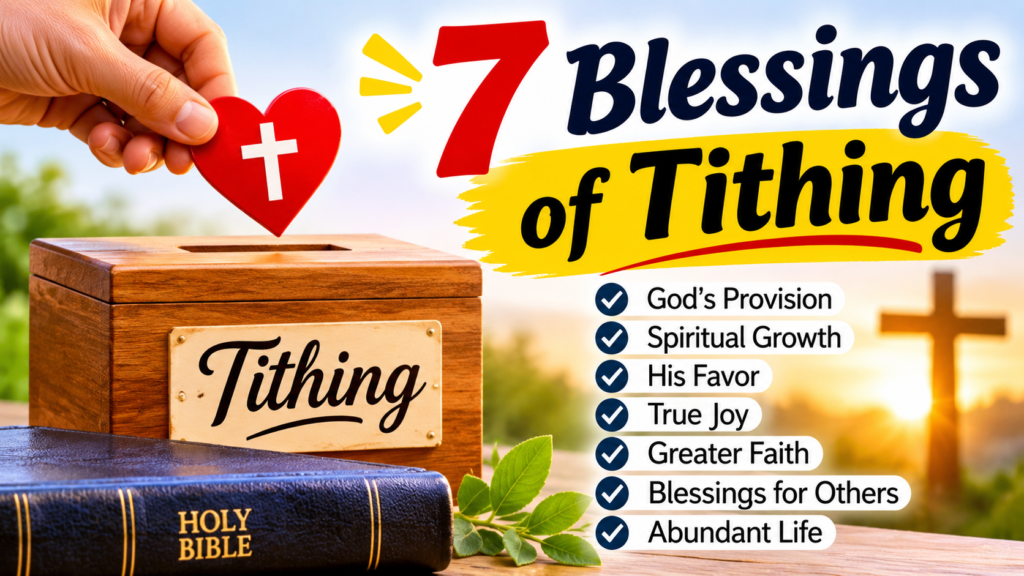
The 7 blessings of tithing come from Malachi 3:10-12: the windows of heaven opened, a blessing poured out beyond measure, the devourer rebuked, a protected harvest, a vine that bears fruit, nations calling you blessed, and a delightful land. These promises were given to Israel for bringing the whole tithe to the storehouse. Believers today read them as God’s pattern of provision and care, not as a guaranteed payout.
What Tithing Means and Why Malachi 3 Matters
What a tithe is
“Tithe” means a tenth. In the Bible, God’s people set apart the first tenth of their produce, flocks, or income for Him. Abraham gave a tenth to Melchizedek (Genesis 14:20), and under the Law of Moses the tithe supported the Levites, who had no land of their own (Numbers 18:21), and the foreigner, the orphan, and the widow (Deuteronomy 14:28-29).
Who Malachi was speaking to
Malachi wrote to Israelites who had returned from exile and let their worship go cold. They were holding back the tithe, and God said so plainly: “Will a man rob God?” (Malachi 3:8). The seven blessings were His answer to a nation that had stopped trusting Him with their harvest.
What the “storehouse” was
The storehouse was the place in the temple where tithes of grain, oil, and animals were kept and handed out to those who served and to people in need. Most churches today treat the local congregation as the closest equivalent, though Christians differ on how directly the comparison holds.
The 7 Blessings of Tithing in Malachi 3:10-12
Here is the passage in the King James Version (public domain):
“Bring ye all the tithes into the storehouse, that there may be meat in mine house, and prove me now herewith, saith the LORD of hosts, if I will not open you the windows of heaven, and pour you out a blessing, that there shall not be room enough to receive it. And I will rebuke the devourer for your sakes, and he shall not destroy the fruits of your ground; neither shall your vine cast her fruit before the time in the field, saith the LORD of hosts. And all nations shall call you blessed: for ye shall be a delightsome land, saith the LORD of hosts.” (Malachi 3:10-12, KJV)
Every blessing below has two parts: what it meant for Israel, and how believers commonly apply it now.
1. “I will open you the windows of heaven”
Then: In an agricultural society, rain meant survival. “Windows of heaven” is the same phrase used for the flood in Genesis 7:11, except here the water brings life instead of judgment. Today: Believers read this as God’s willingness to meet needs generously when His people trust Him first. It is a picture of access to His provision, not a promise of a specific amount.
2. “Pour you out a blessing, that there shall not be room enough to receive it”
Then: A harvest so full the barns could not hold it. Today: Many givers describe this as “enough, and some to share”: bills met, a stretched budget, margin to help someone else. Overflow in Scripture is rarely about luxury. It is about having more than you need so you can give.
3. “I will rebuke the devourer for your sakes”
Then: Most commentators understand the devourer as crop pests such as locusts, which could wipe out a year’s work in days. Today: Believers apply it to anything that eats away at what they have worked for: sudden expenses, waste, instability. The promise is that God takes up your defense. It does not say trouble never arrives.
4. “He shall not destroy the fruits of your ground”
Then: The harvest itself would be protected, so the farmer’s work would not be lost. Today: This is usually read as protection over the results of honest work: your income, your savings, your effort. Many people find it a reason to work diligently and give faithfully together.
5. “Neither shall your vine cast her fruit before the time in the field”
Then: A vine that dropped its fruit early left the grower with nothing. The promise was that what was planted would ripen in its season. Today: It speaks to patience. Some of what you sow in faithful giving and work does not mature on your timetable, and the promise is that it will come to fruit in God’s time.
6. “All nations shall call you blessed”
Then: Israel’s restored faithfulness would be visible to the surrounding peoples, and God’s goodness to them would be a witness. Today: A generous, trusting household or church becomes a quiet testimony. Neighbors notice people who give without fuss and stay steady when money is tight.
7. “Ye shall be a delightsome land”
Then: A land of favor and delight, flourishing under God’s care. Today: Believers see this as a whole-life picture: a community, a family, or a congregation marked by peace and joy rather than anxiety about money. It is the closest of the seven to a description of what a generous life feels like.
The 7 Blessings at a Glance
| # | Promise (Malachi 3:10-12) | What it meant for Israel | How believers apply it today |
|---|---|---|---|
| 1 | Windows of heaven opened | Rain and a life-giving harvest | God’s generous provision |
| 2 | Blessing with no room to contain it | Overflowing barns | Enough, with margin to give |
| 3 | The devourer rebuked | Crop pests held back | Protection from what drains resources |
| 4 | Fruits of the ground not destroyed | A harvest that survives | Protection over the results of work |
| 5 | The vine does not drop its fruit early | Fruit ripens in season | Patience; things mature in God’s time |
| 6 | Nations call you blessed | A visible witness to others | A generous life that others notice |
| 7 | A delightful land | A flourishing, favored nation | Peace and joy in how you live |
What These Promises Do Not Mean
Not a payment
Malachi calls tithing a test of trust (“prove me now herewith”), not a purchase. Giving in order to get something back misses the point. Paul says God loves a cheerful giver, and that giving should not be reluctant or under compulsion (2 Corinthians 9:7).
Not a guarantee of wealth
The promises were made to Israel as a nation under the old covenant. Faithful believers still lose jobs, face illness, and pass through lean years. Most pastors who teach on this passage describe the fruit as provision, protection, and peace, not riches.
Not a substitute for justice and mercy
Jesus told the Pharisees they were right to tithe even mint, dill, and cumin, but wrong to neglect justice, mercy, and faithfulness (Matthew 23:23). The tithe was never meant to replace the rest of obedience.
Is Tithing Still Required Today?
The main Christian views
Christians genuinely disagree here, and thoughtful scholars sit on both sides.
| View | Core idea | Typical passages cited |
|---|---|---|
| The tithe still applies | The tenth predates the Law (Abraham, Jacob) and Jesus affirms it, so ten percent remains the standard | Genesis 14:20; Malachi 3:10; Matthew 23:23 |
| The tithe is a guideline | The tenth is a good starting point for New Testament giving, which goes beyond a fixed rate | 1 Corinthians 16:2; 2 Corinthians 8-9 |
| The tithe is not binding | Tithing belonged to the Mosaic Law; Christians give freely from grace | Romans 6:14; 2 Corinthians 9:7 |
Where most agree
Nearly everyone agrees on three things. Giving is part of the Christian life. It should be generous and cheerful rather than forced. And the heart behind the gift matters more than the number.
What It Sounds Like in Real Life
Sana: Do you really think tithing changed anything for you?
Imran: Not the way people sell it. No sudden windfall. But I stopped dreading the first of the month, and I can’t fully explain why.
Sana: So it didn’t make you rich.
Imran: It made me less afraid of money. I’d take that over rich.
Bilal: I want to start, but ten percent would sink us right now.
Maryam: Then start with what you can keep up every month, even if it’s small.
Bilal: That’s allowed?
Maryam: Nobody’s checking. A steady five beats a stressed ten you give up on in March.
Daniel: Why do you set the gift aside before you even pay the bills?
Hannah: Because if I wait until what’s left, there’s never anything left.
Daniel: Doesn’t that scare you?
Hannah: It did the first year. Now it just feels like the order we do things in.
How to Start Tithing
- Decide your starting point. Pick a percentage you can give consistently. Ten percent is the traditional benchmark.
- Choose gross or net. The Bible does not specify. Many give on gross as a way of honoring God with the firstfruits; others use net. Be consistent.
- Give first. Set a recurring gift for payday so it happens before spending.
- Know where it goes. Most traditions teach that the tithe goes to your home church, with extra offerings elsewhere.
- Review after a few months. Notice what changes in your habits and your peace, not only your balance.
Frequently Asked Questions
What are the 7 blessings of tithing?
They are the seven promises in Malachi 3:10-12: the windows of heaven opened, a blessing beyond measure, the devourer rebuked, the fruit of the ground protected, the vine kept fruitful, the nations calling you blessed, and a delightful land. Together they describe God’s provision and care for those who trust Him first.
Is Malachi 3:10 meant for Christians today?
It was written to Israel under the old covenant. Some Christians apply it directly, others see it as a principle of trust and generosity that carries into the New Testament, and others say it does not bind believers. Read the passage in context and talk with your pastor.
What does “windows of heaven” mean?
It is a picture of abundant supply from God, most likely rain and harvest in Malachi’s farming world. The same phrase appears in the flood story (Genesis 7:11), where it describes an overwhelming outpouring. In Malachi the outpouring is blessing, not judgment.
What is the storehouse in Malachi 3:10?
It was the temple storehouse where tithes of grain, oil, and animals were kept to feed the Levites and the needy. Many churches teach that the local congregation is the modern equivalent, while some argue the comparison is looser.
Does tithing guarantee financial blessing?
No. Scripture links faithful giving with God’s care, but it does not promise wealth. Many believers describe provision, peace, and contentment, and some give faithfully through hard seasons. Malachi’s promises were also given to a specific nation under a specific covenant.
Should I tithe on gross or net income?
The Bible gives no formula. Many people tithe on gross income to honor the firstfruits; others use net. Choose one standard, apply it honestly and consistently, and let your conscience and your church leaders guide you.
What if I can’t afford to tithe?
Start with a smaller percentage you can give steadily and raise it as your situation allows. If you are in real hardship, speak with a pastor. God looks at the heart behind the gift, not only the size of it.
What is the difference between a tithe and an offering?
A tithe is the set-aside tenth, usually given regularly to the local church. An offering is anything given beyond that, for missions, special needs, or gratitude. Many believers give both.
DISCOVER MORE ARTICLES
Free Good Night Blessings to Share With Family and Friends 2026
50 Beautiful Evening Blessings Images to Share with Loved Ones
Good Saturday Morning Blessings Images to Share Today

Shahzad is the Founder of BlessDiary, sharing Christian prayers, blessings, Bible-based encouragement, and inspiring messages to strengthen faith and bring hope to everyday life.