If you searched for a count your blessings Bible verse, you may be hunting for one specific line, and here is the surprise: those exact words are not in Scripture. They come from a hymn. That does not mean the Bible is quiet on the subject. It uses counting language more often than most people notice: stars nobody can number, benefits nobody can add up, days we are told to count.
This page sorts it out in order. First, where the phrase really comes from. Then the verses that actually talk about counting, followed by scriptures grouped by what you are going through, from a rough week to a family dinner. Quotes are from the King James Version, which is public domain, so you can copy them freely.
Quick answer: No, “count your blessings” is not a Bible verse. It comes from an 1897 hymn by Johnson Oatman Jr. The closest verses are Psalm 103:2 (“forget not all his benefits”), Psalm 139:17-18 and Psalm 40:5.
Old words in the KJV: thee/thou = you, hath = has, loadeth = loads, tell = count.
Jump to:
- Which verse for which use
- Is “Count Your Blessings” in the Bible?
- Where the Bible actually talks about counting
- Verses for hard seasons
- Short verses for captions and cards
- Verses for ordinary days
- Verses for prayer and anxiety
- Verses about remembering and telling
- How to count your blessings (5 steps)
- Real-life conversations
- FAQ
Which Verse for Which Use
| Use | Verse to try |
|---|---|
| Journaling or devotions | Psalm 103:2-5 |
| Social media caption | Psalm 118:24 or Psalm 107:1 |
| Thanksgiving table | Deuteronomy 8:10 or Psalm 68:19 |
| After a hard year | Lamentations 3:22-23 |
| Card for a friend | Psalm 126:3 or Colossians 3:15 |
| New Year reflection | Psalm 77:11-12 |
| When anxious | Philippians 4:6 |
| Teaching children | Psalm 100:4 |
| Sermon or talk on counting | Psalm 40:5 and Philippians 4:8 |
A note on translations: the King James Version is public domain. If you prefer the NIV, ESV, NLT or another modern translation, check the publisher’s permission guidelines before quoting at length online or in print.
Is “Count Your Blessings” in the Bible?
Question: Is “count your blessings” a Bible verse?
Answer: No, the exact phrase is not in Scripture. It comes from Johnson Oatman Jr.’s 1897 hymn, first printed in Songs for Young People. The idea is thoroughly biblical, though: Psalm 103:2 says to forget not all God’s benefits, and Psalm 40:5 and Psalm 139:17-18 describe God’s works and thoughts as too many to number.
The hymn’s words were written by Johnson Oatman Jr., born in New Jersey in 1856, a Methodist minister and businessman who went on to write thousands of hymn texts. The tune was composed by Edwin O. Excell, who compiled the collection it first appeared in, published in Chicago in 1897. Hymn reference sites tie it to Psalm 40:5-6, Psalm 107:31, Ephesians 1:3 and 1 Thessalonians 5:18.
Why does this matter? If you are printing a church bulletin, writing a card, or preparing a talk, “inspired by Psalm 103:2” is accurate. “The Bible says, count your blessings” is not.
Where the Bible Actually Talks About Counting
Most lists jump straight to general thankfulness verses. These six are the ones that use the language of counting, numbering and reckoning, and they are the closest you will get to the phrase itself. (Psalm 90:12 and Philippians 4:8 are the loosest fits: one counts days, the other reckons what is worth dwelling on.)
1. Psalm 103:2-5 “Bless the LORD, O my soul, and forget not all his benefits: Who forgiveth all thine iniquities; who healeth all thy diseases; Who redeemeth thy life from destruction; who crowneth thee with lovingkindness and tender mercies; Who satisfieth thy mouth with good things; so that thy youth is renewed like the eagle’s.” Almost everyone quotes only verse 2. Read on and verses 3 to 5 become the actual list of “benefits”: forgiveness, healing, rescue, love, provision, renewal. It is the best template in the Bible for a gratitude list, and we will use it in the practice section below.
2. Psalm 40:5 “Many, O LORD my God, are thy wonderful works which thou hast done, and thy thoughts which are to us-ward: they cannot be reckoned up in order unto thee: if I would declare and speak of them, they are more than can be numbered.” This verse admits the task is impossible. You will never finish the list. The point is to start anyway.
3. Psalm 139:17-18 “How precious also are thy thoughts unto me, O God! how great is the sum of them! If I should count them, they are more in number than the sand: when I awake, I am still with thee.” Of the verses here, it is the one that uses the word “count” itself. Strictly, the psalmist is counting God’s thoughts toward him, not a list of gifts, but the habit is the same. Notice how it ends: not with a total, but with waking up and still being held.
4. Genesis 15:5 “And he brought him forth abroad, and said, Look now toward heaven, and tell the stars, if thou be able to number them: and he said unto him, So shall thy seed be.” In older English, “tell” means count. God gives the exercise to a man who had been waiting a long time for a promise, and the number he is asked to reach is one he cannot reach.
5. Psalm 90:12 “So teach us to number our days, that we may apply our hearts unto wisdom.” This counts days rather than blessings, but it is the same habit: paying attention to what you have been given before it passes.
6. Philippians 4:8 “Finally, brethren, whatsoever things are true, whatsoever things are honest, whatsoever things are just, whatsoever things are pure, whatsoever things are lovely, whatsoever things are of good report; if there be any virtue, and if there be any praise, think on these things.” Here is something most “count your blessings” pages miss. The Greek verb behind “think on” is logizomai, a bookkeeping word meaning to reckon or take account of something. Read that way, Paul is asking for more than pleasant thoughts. He is asking you to take inventory of what is true, lovely and praiseworthy, and add it up. The same verb is translated “counted” in Romans 4:3.
A common mix-up: “count it all joy”
James 1:2 says, “My brethren, count it all joy when ye fall into divers temptations.” People often treat this as a counting-blessings verse. It is not quite the same thing. James uses a different Greek verb, hegeomai, which means to consider or regard, and he is talking about trials, not gifts. It is a verse about how to view hardship, so use it for that.
Bible Verses for Hard Seasons
Counting blessings is not pretending things are fine. Some of the strongest thankfulness verses were written by people who had lost almost everything.
7. Lamentations 3:22-23 “It is of the LORD’s mercies that we are not consumed, because his compassions fail not. They are new every morning: great is thy faithfulness.” The book of Lamentations mourns a destroyed city. This line sits in the middle of the rubble, which is why it carries weight.
8. Habakkuk 3:17-18 “Although the fig tree shall not blossom, neither shall fruit be in the vines; the labour of the olive shall fail, and the fields shall yield no meat; the flock shall be cut off from the fold, and there shall be no herd in the stalls: Yet I will rejoice in the LORD, I will joy in the God of my salvation.” Look at how specific the loss is: no figs, no grapes, no olives, no sheep. The hinge of the whole passage is one small word, “Yet.”
9. Job 1:21 “…the LORD gave, and the LORD hath taken away; blessed be the name of the LORD.” Said by a man at the worst moment of his life. It is a verse to hold for yourself, not one to hand to someone who is grieving.
10. Psalm 42:11 “Why art thou cast down, O my soul? and why art thou disquieted within me? hope thou in God: for I shall yet praise him.” Again that word “yet.” The writer is not grateful yet. He is talking himself toward it.
11. Philippians 4:11 “…for I have learned, in whatsoever state I am, therewith to be content.” Paul wrote this letter from prison. The verb is “learned.” Contentment here is a skill practiced, not a mood.
Short Verses for Captions, Cards and Texts
12. Psalm 107:1: “O give thanks unto the LORD, for he is good: for his mercy endureth for ever.”
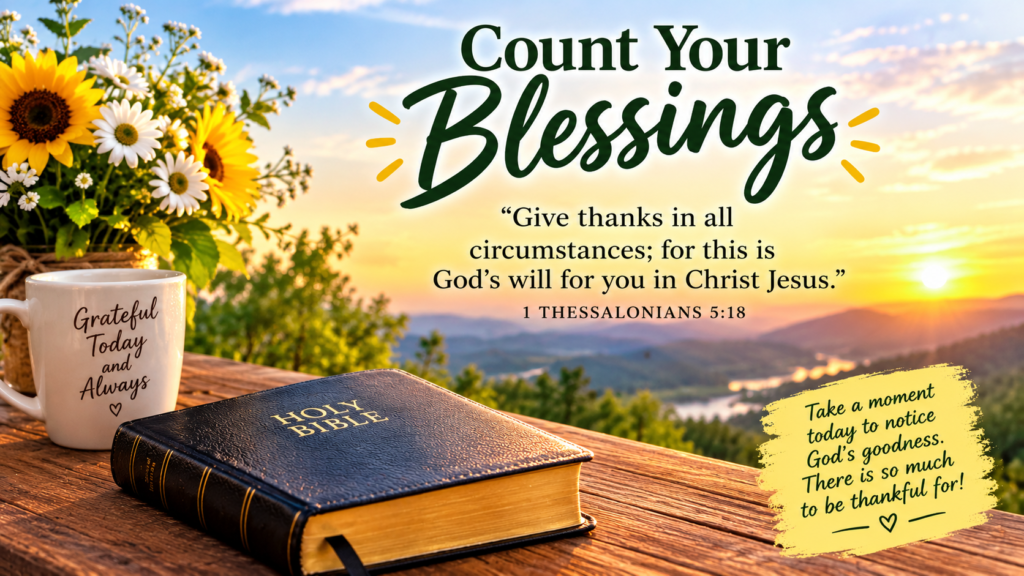
13. 1 Thessalonians 5:18: “In every thing give thanks: for this is the will of God in Christ Jesus concerning you.”
14. Psalm 118:24: “This is the day which the LORD hath made; we will rejoice and be glad in it.”
15. Psalm 34:1: “I will bless the LORD at all times: his praise shall continually be in my mouth.
16. Colossians 3:15 (last words): “…and be ye thankful.”
Verses for Ordinary Days
Most gratitude happens at a sink, a bus stop or a dinner table, not at a mountaintop moment.
17. James 1:17 “Every good gift and every perfect gift is from above, and cometh down from the Father of lights.” Good for the unglamorous items on your list: the working car, the friend who texted, the hot water.
18. Psalm 68:19 “Blessed be the Lord, who daily loadeth us with benefits, even the God of our salvation.” The key word is “daily.” Not annually, not on holidays.
19. Deuteronomy 8:10-11 “When thou hast eaten and art full, then thou shalt bless the LORD thy God for the good land which he hath given thee. Beware that thou forget not the LORD thy God…” This was spoken to people about to enter a land of plenty. The warning is not about hunger. It is about forgetting once you are comfortable.
20. Psalm 126:3 “The LORD hath done great things for us; whereof we are glad.” Short and warm. It fits a family gathering, a baby’s birth or a church testimony night.
21. Psalm 100:4 “Enter into his gates with thanksgiving, and into his courts with praise: be thankful unto him, and bless his name.”
Verses for Prayer and Anxiety
22. Philippians 4:6 “Be careful for nothing; but in every thing by prayer and supplication with thanksgiving let your requests be made known unto God.” “Be careful for nothing” means do not be anxious. Notice thanksgiving travels with the request, not after it is answered.
23. Ephesians 5:20 “Giving thanks always for all things unto God and the Father in the name of our Lord Jesus Christ.”
24. Psalm 28:7 “The LORD is my strength and my shield; my heart trusted in him, and I am helped: therefore my heart greatly rejoiceth; and with my song will I praise him.”
Verses About Remembering and Telling
Counting is half the habit. The other half is saying it out loud.
25. Psalm 77:11-12 “I will remember the works of the LORD: surely I will remember thy wonders of old. I will meditate also of all thy work, and talk of thy doings.”
26. Psalm 66:16 “Come and hear, all ye that fear God, and I will declare what he hath done for my soul.”
27. Psalm 116:12 “What shall I render unto the LORD for all his benefits toward me?” A good question to ask after you finish a list. What do I do with all of this?
28. Psalm 105:1 “O give thanks unto the LORD; call upon his name: make known his deeds among the people.”
Luke 17 shows the cost of not telling. Jesus heals ten men with leprosy and only one returns to thank him. Jesus asks, “Were there not ten cleansed? but where are the nine?” All ten got the blessing. One noticed it.
How to Count Your Blessings Using the Bible’s Own List
You do not need a blank page and a vague instruction. Scripture hands you prompts.
- Start with Psalm 103:3-5. Write one specific line for each of the six benefits: something you were forgiven for, a time your health held up, something you were rescued from, a person who showed you love, food or provision you did not earn, and a moment you felt renewed. “Rescued” might be “the tire blew on the highway and nobody was hurt.” Specific beats general.
- Add one spiritual item from Ephesians 1:3, which says believers are blessed “with all spiritual blessings in heavenly places in Christ.” This keeps the list from being only about comfort.
- Do one Philippians 4:8 pass. Name one true thing, one lovely thing, and one piece of good news you heard about someone else.
- Say one aloud to a person, the way Psalm 66:16 describes.
- Repeat tomorrow without copying yesterday. That is what trains attention.
If the list stays empty on a bad day, do not force it. Start with the smallest thing you can name. The Psalms also include plenty of honest complaint, and nothing says you must skip it.
Real-Life Conversations
Choosing a caption
Sarah: I need a verse for the photo of Dad’s first day home. Not too long.
Naveed: Psalm 126:3. “The LORD hath done great things for us; whereof we are glad.”
Sarah: That’s it. It says what all of us are thinking.
In a church office
Ruth: Someone wants “Count your blessings” printed on the bulletin with a verse number next to it.
Daniel: It’s not in the Bible word for word. It’s from a hymn, 1897.
Ruth: So what do I print?
Daniel: Psalm 103:2 and a line saying the hymn was inspired by it. That’s accurate and it still looks good.
After a failed exam
Agnes: Write down what went right this semester.
Tom: Nothing went right. I failed.
Agnes: You got up at five for the bus every single day, even in winter.
Tom: That’s not a blessing, that’s just a bus.
Agnes: It’s a habit you built. Write it down anyway.
Frequently Asked Questions
What Bible verse is closest to “count your blessings”?
Psalm 103:2, “forget not all his benefits,” is the most common source. For wording that uses the idea of counting, Psalm 139:17-18 and Psalm 40:5 are closer.
Who wrote the hymn “Count Your Blessings”?
Johnson Oatman Jr. wrote the words and Edwin O. Excell composed the tune. It was published in 1897 and is in the public domain.
Is “count it all joy” the same as counting blessings?
Not exactly. James 1:2 is about how to regard trials, using a Greek word meaning to consider. Counting blessings is about noticing gifts. The two can work together, but they are different instructions.
Which verse works best for a short caption?
Psalm 107:1 or Psalm 118:24 are short and familiar. For something shorter still, “and be ye thankful” from Colossians 3:15 works.
Is it wrong to count blessings when I am grieving?
No, but it should not be used to silence grief. Lamentations and many Psalms hold sorrow and gratitude side by side. You can say both.
Can I put these verses on Instagram or in printed cards?
KJV text is public domain, so yes. For NIV, ESV, NLT and similar, check the publisher’s permissions page for limits.
How can I teach children to count their blessings?
Keep it daily and concrete. At bedtime ask, “What was one good thing today?” and accept any answer. Pair it with a short verse like Psalm 100:4.
DISCOVER MORE ARTICLES
Tiny Blessings Owasso: 3D/4D Ultrasound Studio Guide 2026
African American Sunday Blessings Images and Quotes 2026
Good Friday Morning Blessings Images and Quotes 2026

Shahzad is the Founder of BlessDiary, sharing Christian prayers, blessings, Bible-based encouragement, and inspiring messages to strengthen faith and bring hope to everyday life.