Someone tells you to “count your blessings,” and you can’t tell if you’ve just been comforted or gently told off. Honestly, it could be either. The words mean one simple thing, but how they land depends on who says them and what kind of day you’re having.
Here’s the count your blessings meaning in plain language, where the saying comes from, how people really use it, and when it helps or backfires. There are examples too, plus a few ways to practice it without it feeling like homework.
What Does “Count Your Blessings” Mean?
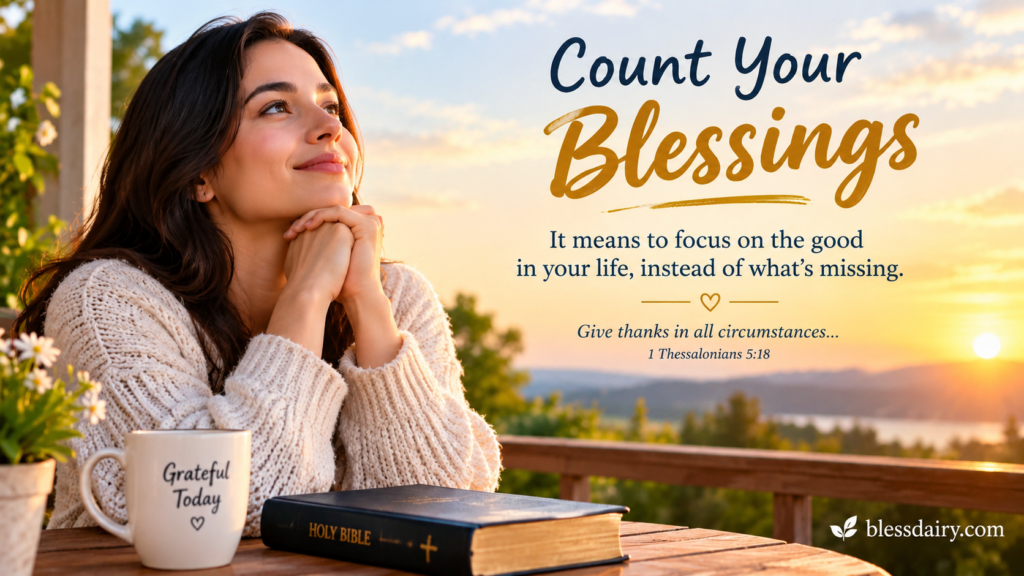
To count your blessings means to notice the good things you already have, like your health, the people who care about you, a safe place to sleep, or a decent cup of tea, instead of fixating on what’s missing or going wrong. It’s an idiom about gratitude and perspective, so nobody expects you to count anything literally. Merriam-Webster describes it as making a deliberate effort to appreciate the good things in your life.
When you’re stressed, your attention locks onto the one thing that’s broken. The phrase asks you to look around at everything else: what’s working, what you stopped noticing years ago, and what you’d badly miss if it vanished tomorrow.
A “blessing” here doesn’t have to be religious. It’s just something good in your life that you didn’t completely earn or control. A friend who picks up the phone. A roof that doesn’t leak. A body that mostly cooperates.
Count Your Blessings, My Blessings, or One’s Blessings?
Dictionaries list the idiom as “count one’s blessings,” but in real speech the pronoun just changes to fit the person: “I’m counting my blessings,” “she counts her blessings,” “let’s count our blessings.” The word “blessings” stays plural. “Count your blessing” sounds off because the whole idea is about many small good things, not one big one.
Where Does the Phrase Come From?
Nobody can name the first person who said it. Even Shakespeare, who gets credit for half the sayings in English, never used this exact wording. What we can trace is the idea, and it’s an old one, especially in religious traditions where good things are seen as gifts.
You’ll sometimes read that it goes back to a Jewish teaching about saying a hundred blessings a day. It’s a nice thread, but nobody has proven it connects to the English idiom, so take it as a possibility, not a fact. Plenty of faiths have their own version of the habit, such as shukr (gratitude) in Islam or saying grace before a meal in Christianity.
Two cultural moments kept the phrase alive in everyday English:
- A gospel hymn from 1897, “Count Your Blessings,” with words by Johnson Oatman Jr. and music by Edwin O. Excell. It became a favorite in churches and Sunday schools, and a lot of people learned the words long before they thought about what they meant.
- A song from the 1954 film White Christmas, “Count Your Blessings Instead of Sheep,” written by Irving Berlin. Berlin reportedly got the idea when stress kept him awake and his doctor told him to count his blessings instead of sheep. The song earned an Oscar nomination for Best Original Song.
Neither one invented the saying. Both borrowed an expression people were already using, and it kept traveling through churches, family kitchens, and ordinary conversation until it became the all-purpose reminder it is today.
If you came here looking for a song rather than a saying, there are several with this title, including the hymn, Berlin’s film song, and a 2006 album by the British band Bring Me the Horizon. This page is about the phrase itself.
How People Actually Use It
The meaning stays put, but the tone changes a lot depending on who’s talking. These are the five ways you’ll hear it most.
1. As comfort. A gentle reminder after a bad day. “The flight got cancelled, but we’re all safe and the hotel has decent food. Count your blessings.”
2. As perspective. Putting a problem back in proportion. “My phone broke the day before my sister’s wedding. Annoying, but I’m counting my blessings: she’s happy, and we all got there.”
3. As relief after a close call. Said when things could have gone much worse. “You walked away from that crash without a scratch. Count your blessings.”
4. As a mild scolding. Often from parents or elders. “You have a job, a home, and good health. Count your blessings and stop complaining about the commute.”
5. As sarcasm. Usually through gritted teeth. “Oh, you only lost an hour in traffic? Count your blessings.”
The last two are why the phrase has a bad reputation, and the conversations below show how that happens.
Real-Life Conversation Examples
After a hard week
Sana: This week has been awful. The deadline moved, my laptop crashed, and I haven’t slept.
Bilal: That’s a lot. Is the work saved?
Sana: Yeah, I’d backed it up Monday.
Bilal: Okay, so that’s one blessing already. Doesn’t make the week less awful, though.
Sana: Thank you for not saying “it could be worse.”
Between parent and teenager
Mariam: Everyone else got the new phone. Mine is three years old.
Her father: Does it still work?
Mariam: Yes, but that’s not the point.
Her father: It’s a little bit the point. Count your blessings, beta.
Mariam: You say that every time.
Her father: Because it’s true every time.
When it goes wrong
Usman: I got laid off yesterday.
Tariq: Hey, at least you have savings. Count your blessings.
Usman: I know. I just wanted to be upset for a minute.
Tariq: Fair. Sorry. Be upset. I’ll buy the tea.
A quiet, genuine one
Hina: My grandmother’s recovering well. The doctors said she can go home Friday.
Zain: That’s wonderful.
Hina: I keep thinking about how scared we were last month. I’m counting my blessings today.
Zain: You should. Today’s a good day for it.
See the pattern? When people say it about their own life, it sounds warm. When it’s pointed at someone who’s in the middle of something painful, it can feel like being told to stop feeling it.
When “Count Your Blessings” Helps (and When It Doesn’t)
This is the part that decides whether the phrase works or goes wrong.
It helps when:
- You say it to yourself, not to someone who’s hurting.
- The problem is real but small or temporary.
- You’re stuck in a loop of comparing or complaining.
- The other person has already been heard and is ready for some perspective.
It backfires when:
- Someone is grieving, sick, or in a crisis and just needs a listener.
- It’s used to shut down a fair complaint (“you shouldn’t be upset”).
- It carries an unspoken “other people have it worse,” which piles guilt on top of pain.
- It’s aimed at serious problems like abuse, unfair treatment, or burnout, where gratitude was never the issue.
Gratitude and difficulty can sit side by side. You can love your family and still be worn out by your job. Counting blessings doesn’t cancel a hard feeling. It just stops that feeling from being the only thing in the room.
Why People Say Gratitude Helps
The research on gratitude is real, but it’s modest. The study people usually point to is “Counting Blessings Versus Burdens,” published in 2003 in the Journal of Personality and Social Psychology by psychologists Robert Emmons and Michael McCullough. Participants regularly wrote down things they were grateful for, while other groups listed daily hassles or neutral events. The grateful groups showed better well-being on several of the measures the researchers tracked, though not all of them.
Gratitude journaling has become a popular habit since then, but the effects tend to be small to moderate and differ from person to person. It won’t cure depression or anxiety, and it works better as a habit than as an emergency fix.
The likely reason is pretty ordinary: attention is selective. Problems shout and good things whisper, so writing or naming the good ones puts them back in view.
Similar Expressions
These sound alike, but each has its own tone:
| Expression | Rough meaning | Difference from “count your blessings” |
|---|---|---|
| Look on the bright side | Focus on the positive in a bad situation | Reactive and cheerful; about this specific situation |
| It could be worse | Compare to a worse outcome | Comparison-based; can feel dismissive |
| Count your lucky stars | Be glad about your good luck, often after a near miss | About luck in one event, not your life overall |
| Be thankful for small mercies | Appreciate minor good luck in a bad situation | Dryer, a little wry |
| A blessing in disguise | Something that seemed bad turns out good | About an outcome, not a habit of gratitude |
| Every cloud has a silver lining | Something good comes out of bad things | About outcomes, not gratitude |
| Grateful for what you have | Appreciate your present life | Plainer, no idiom |
“Count your blessings” is the widest of the bunch. It’s about your whole life, not one bad moment.
Ways to Say It Differently
If “count your blessings” sounds preachy to you, these get at the same idea more softly:
- “Let’s list what’s still going right.”
- “What’s one thing that’s okay today?”
- “I’m grateful for ___ even if the rest is messy.”
- “At least we’re together.”
- “Some good things happened too. Want to hear them?”
Easy Ways to Practice It Without Making It a Chore
Counting works best when it’s small and specific.
- Name two or three things at night. Skip “my family” every single time. Try “the neighbor held the door when my hands were full.” If you like ending the day with a few kind words, these evening blessings go well with the habit.
- Go specific, not grand. “Hot tea at 4 p.m.” makes you notice something. “My health” usually doesn’t.
- Notice what’s usually invisible. Running water, a working lock, a friend who actually replies.
- Say it to the person. A quick text like “I’m glad you’re in my life” turns a private thought into something they can feel. If you want ready-made words, these blessing wishes cover most situations.
- Skip it on bad days if it feels forced. A rushed list can start to feel like one more thing you’re failing at.
Frequently Asked Questions
What does “count your blessings” mean in simple words?
It means to notice and appreciate the good things in your life instead of focusing only on your problems, whether those good things are big or small.
Where does “count your blessings” come from?
Nobody knows the exact origin. The idea comes from religious traditions that treat good things as gifts, and the phrase spread through a late-1800s hymn and a 1954 film song. A Jewish teaching about a hundred daily blessings is sometimes linked to it, but that connection isn’t confirmed.
Is “count your blessings” a religious phrase?
Not necessarily. It probably has religious roots, since blessings were once seen as gifts from God, but most people today use it in a general way to mean “be grateful.”
Is it rude to tell someone to count their blessings?
It can be, especially if the person is hurting and wants support. To someone in pain, it can sound like you’re brushing off their feelings. It’s usually kinder to listen first and offer perspective later, or only if they ask for it.
What is the difference between “count your blessings” and “look on the bright side”?
“Look on the bright side” is about finding something good in one specific bad situation. “Count your blessings” is wider and is about being thankful for your life overall.
Is it “count your blessings” or “count one’s blessings”?
They’re the same idiom. “Count one’s blessings” is the dictionary form, and in speech people swap in the right pronoun: my, your, her, our. “Blessings” always stays plural.
What is another way to say “count your blessings”?
You could say “be thankful for what you have,” “count your lucky stars” (when the good comes from luck), or “look at what’s going right.”
Does counting your blessings actually work?
For many people it lifts their mood and shifts their attention, especially when it becomes a regular habit. The effect is usually modest, and it’s no substitute for professional support if you’re struggling with your mental health.
How do you count your blessings in practice?
Pick a regular moment, like right before bed, and name two or three specific good things from that day. Small details work better than broad ones.
What’s the opposite of counting your blessings?
Dwelling on what you lack or measuring yourself against other people and coming up short. Some people call it “counting your troubles.”
Can I use it in a formal or professional setting?
It’s fine in warm, personal settings. At work, it can come across as patronizing if you aim it at a colleague, so keep it for yourself or for lighthearted moments.
DISCOVER MORE ARTICLES
Beautiful Good Morning Saturday Blessings to Share 2026
Sunday Blessings Images and Quotes to Share 2026
Tuesday Morning Prayers and Blessings for a Blessed Day 2026

Shahzad is the Founder of BlessDiary, sharing Christian prayers, blessings, Bible-based encouragement, and inspiring messages to strengthen faith and bring hope to everyday life.