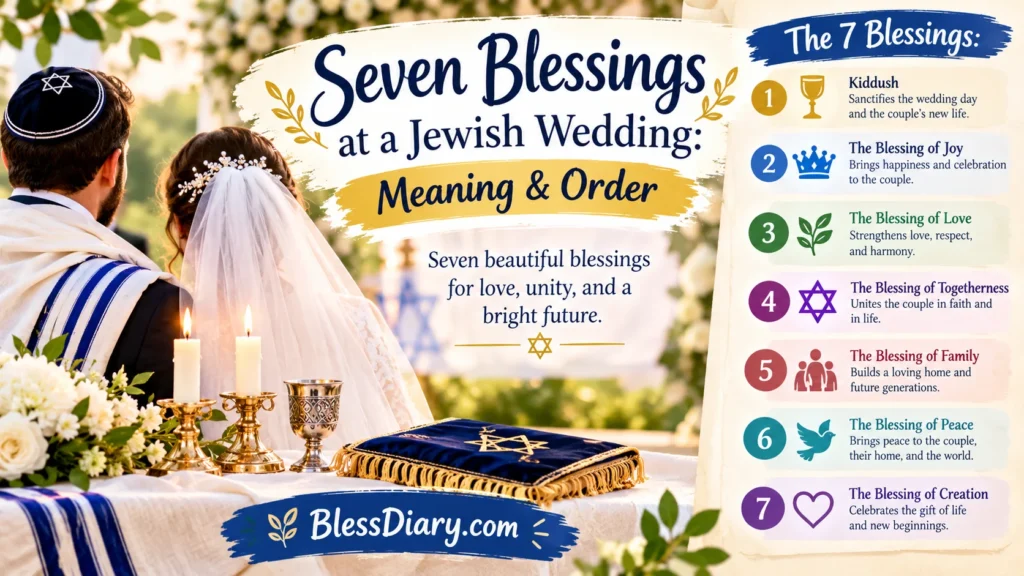
The seven blessings at a Jewish wedding, known as Sheva Berachot (Sheva Brachot), are traditional Hebrew blessings recited beneath the chuppah during the marriage ceremony. They celebrate creation, humanity, love, companionship, and the couple’s future happiness.
These blessings are also recited at certain festive meals during the week following the wedding, bringing family and friends together to celebrate the newly married couple.
Whether you are planning a Jewish wedding, attending the ceremony, or simply curious about this beautiful tradition, this guide explains all seven blessings in order, their meanings, who recites them, and when they are traditionally said.
What Are the Seven Blessings at a Jewish Wedding?
Sheva Berachot is a Hebrew phrase meaning “seven blessings.” These blessings are also known as Birkat Nisuin, referring to the blessings associated with the marriage stage of a Jewish wedding.
Traditionally, the seven blessings are recited over a cup of wine beneath the chuppah, the canopy under which the couple stands during the ceremony.
The blessings have a meaningful progression. They begin by praising God as the creator of the world, recognize the creation and dignity of humanity, remember Jerusalem, and conclude with prayers for the happiness, love, and companionship of the newly married couple.
The seven blessings are not simply seven individual wishes. Together, they connect marriage with Jewish faith, family, community, creation, and the hope for a joyful future.
The traditional text is recited in Hebrew, although many couples include English translations so guests can understand the words and their significance.
The Seven Jewish Wedding Blessings in Order
The seven blessings follow a traditional sequence. Each one has its own theme and meaning, moving from gratitude for creation toward the personal happiness of the bride and groom.
Here is what each blessing celebrates in simple English.
1. The Blessing Over Wine
The first blessing praises God as the creator of the fruit of the vine.
Wine has an important place in Jewish religious celebrations. It is traditionally used during Shabbat, holidays, and other meaningful occasions.
At a Jewish wedding, this blessing introduces the seven blessings and establishes a celebratory atmosphere.
Meaning: Gratitude for God’s creation and the joy represented by wine.
2. All Things Created for God’s Glory
The second blessing praises God for creating everything for divine glory.
Unlike the first blessing, which focuses on wine, this blessing takes a broader view of the world. It recognizes that creation has a purpose beyond the wedding celebration itself.
It reminds the couple that their marriage is part of a much larger story involving faith, humanity, and the world around them.
Meaning: Recognizing God as the creator and celebrating the purpose of creation.
3. The Creator of Humanity
The third blessing praises God as the creator of humanity.
It shifts attention from the world as a whole to human life. The blessing recognizes the significance of human creation and prepares for the following blessing, which reflects on humanity’s relationship and shared existence.
Meaning: Gratitude for human life and the creation of mankind.
4. Humanity Created in the Divine Image
The fourth blessing refers to humanity being created in the divine image.
It celebrates human dignity and the relationship between people. In the context of marriage, it provides a deeper reflection on companionship, family, and the possibility of building a meaningful home together.
Marriage is presented as more than a romantic celebration. It is also connected with continuity, responsibility, and the future of human relationships.
Meaning: Honoring human dignity, companionship, and the importance of building a shared life.
5. The Joy of Zion and Jerusalem
The fifth blessing introduces Jerusalem and Zion into the wedding celebration.
It uses imagery of joy and restoration, expressing the hope that Jerusalem will experience happiness and renewed celebration.
Some guests may wonder why a wedding blessing mentions a city rather than focusing entirely on the couple.
The reason is that Jewish celebrations often connect personal happiness with the wider history, identity, and hopes of the Jewish people.
Even during a joyful occasion, this blessing remembers the importance of Jerusalem.
Meaning: Celebrating hope, restoration, and the joy of Jerusalem.
6. The Happiness of the Couple
The sixth blessing turns directly toward the newly married couple.
It asks for happiness for the beloved pair, drawing on the image of the first human companions in the Garden of Eden.
The blessing connects marriage with love, companionship, and the joy of beginning a shared life.
It expresses a hope that the couple’s happiness will be meaningful and lasting, extending beyond their wedding day.
Meaning: A prayer for the couple’s happiness, love, and companionship.
7. Joy, Love, Peace, and Companionship
The seventh blessing is the longest and brings the sequence to its conclusion.
It includes expressions of happiness such as joy, gladness, love, peace, delight, and companionship.
It also expresses the hope that celebration and happiness will be heard throughout Jerusalem and among the Jewish people.
The blessing concludes with praise to God for bringing joy to the groom and bride, according to the traditional wording.
Meaning: A prayer for lasting love, happiness, peace, and shared joy.
Quick Comparison: What Each of the Seven Blessings Means
The following table provides a simple overview of all seven blessings so readers can understand their meanings at a glance.
| Blessing | Main Focus | Meaning |
|---|---|---|
| First | Wine | Gratitude for the fruit of the vine |
| Second | Creation | Everything exists for God’s glory |
| Third | Humanity | God as the creator of human life |
| Fourth | Divine image | Human dignity and relationships |
| Fifth | Jerusalem | Hope, restoration, and communal joy |
| Sixth | The couple | Happiness and companionship |
| Seventh | Shared celebration | Love, peace, and lasting joy |
Together, these blessings move from the creation of the world to the happiness of two people beginning their married life.
When Are the Seven Blessings Recited During a Jewish Wedding?
The seven blessings are traditionally recited during the Nisuin portion of a Jewish wedding ceremony.
A traditional Jewish wedding includes two important stages: Kiddushin and Nisuin. Understanding the difference helps explain where the seven blessings belong.
Kiddushin: The Betrothal Stage
Kiddushin is the first stage of the traditional Jewish marriage ceremony.
It commonly includes a blessing over wine, followed by the exchange of rings and the traditional declaration.
The couple stands beneath the chuppah, and the ceremony begins with these meaningful rituals.
Nisuin: The Marriage Blessings
Nisuin is the marriage stage associated with the seven blessings.
In a commonly followed ceremony order, the ketubah, or Jewish marriage contract, is read before the seven blessings are recited.
The blessings are traditionally said over a cup of wine. After their recitation, the couple drinks from the cup.
Other familiar wedding customs include the breaking of the glass and yichud, a private moment for the newly married couple. Their precise placement and practice can vary between communities.
The rabbi or officiant guides the ceremony and explains the appropriate order according to the couple’s tradition.
Who Says the Seven Blessings at a Jewish Wedding?
The seven blessings may be recited by a rabbi, cantor, or invited members of the couple’s family and community, depending on the Jewish tradition being followed.
Many couples choose to share this meaningful part of their wedding with people who have played important roles in their lives.
Possible participants include:
- Parents of the bride and groom.
- Grandparents and other close relatives.
- Brothers and sisters.
- Close friends.
- Teachers, mentors, and respected community members.
Some couples invite several people to participate, while others ask the rabbi or cantor to recite all seven blessings.
Do seven different guests each have to read one blessing?
No. The arrangement is not always one person per blessing. In some traditional arrangements, the first two blessings are assigned together to one person and the remaining five to five other participants.
The exact arrangement depends on the community’s custom and the officiant’s guidance.
Couples should discuss the selection of participants with their rabbi before finalizing the wedding program.
Are the Seven Blessings Said in Hebrew or English?
The traditional seven wedding blessings are written and recited in Hebrew.
However, many Jewish weddings also include English translations to help guests understand the meaning of each blessing.
Depending on the ceremony and community, couples may choose to:
- Have the rabbi or cantor recite the traditional Hebrew blessings.
- Provide English translations in the wedding program.
- Invite participants to read an English explanation after the Hebrew.
- Include transliteration for guests who want to follow the Hebrew pronunciation.
For guests unfamiliar with Hebrew, an English translation makes the ceremony easier to understand and helps everyone appreciate the meaning behind the words.
Couples who want to use adapted wording should discuss it with their officiant in advance.
How Jewish Wedding Customs Differ Between Communities
Jewish wedding traditions share many important elements, but the way the seven blessings are presented can differ between communities.
The wording, melodies, participation arrangements, and use of translations may depend on religious movement and family tradition.
Orthodox Jewish Weddings
Orthodox weddings generally follow the traditional Hebrew liturgy and established religious requirements.
The seven blessings are recited according to traditional practice. Post-wedding Sheva Berachot meals may also follow specific requirements involving a minyan and other customary conditions.
Conservative Jewish Weddings
Conservative communities generally retain the traditional Hebrew blessings.
English translations or explanations may also be included to help guests understand the ceremony. Participation arrangements and other details should be confirmed with the officiant.
Reform and Progressive Jewish Weddings
Reform and other progressive communities may include English readings, adapted wording, or additional interpretations.
Some couples choose language that reflects their relationship and family circumstances while retaining the themes of the traditional blessings.
Sephardi and Mizrahi Jewish Weddings
Sephardi and Mizrahi communities have distinctive melodies and family customs associated with Jewish weddings.
The way the blessings are chanted may differ from Ashkenazi traditions.
For couples whose families come from different Jewish backgrounds, incorporating meaningful elements from both traditions can make the ceremony especially personal.
Important: These are broad descriptions. Individual synagogues and families may follow different customs. Couples should confirm the exact wording and ceremony arrangements with their rabbi or officiant.
What Are Sheva Berachot Meals After the Wedding?
Sheva Berachot meals are festive gatherings held in honor of the newly married couple during the week following their wedding.
The same seven blessings may be recited again at qualifying meals, traditionally after the meal and in accordance with the community’s religious requirements.
These gatherings allow family members, friends, and the wider Jewish community to continue celebrating the marriage.
Rather than limiting the celebration to one wedding day, the tradition creates opportunities for the newlyweds to spend time with different groups of loved ones.
Who Hosts Sheva Berachot Meals?
Family members, relatives, and friends may organize these gatherings.
Some couples attend meals hosted by their parents, while others celebrate with friends or members of their synagogue community.
Are There Special Requirements?
In traditional Jewish practice, certain requirements apply to meals where the seven blessings are recited.
Depending on the community, these may include:
- The presence of the bride and groom.
- A festive meal.
- A minyan, or required prayer quorum.
- A new face, known in Hebrew as panim chadashot, at certain meals.
The exact requirements depend on the applicable Jewish tradition and circumstances.
Couples and hosts should consult their rabbi rather than assume that every dinner automatically qualifies for the recitation.
How to Choose and Prepare People to Recite the Seven Blessings
Choosing the people who will participate in the seven blessings is an opportunity to recognize those who have supported the couple throughout their lives.
A little preparation can also make the ceremony more comfortable for everyone.
Here are practical suggestions for couples planning this part of their wedding.
1. Ask the rabbi first.
Before inviting participants, confirm how the blessings will be divided and who may recite them according to your community’s practice.
2. Choose people who are meaningful to you.
Parents, grandparents, siblings, relatives, mentors, and close friends may be appropriate choices where the community’s rules permit.
3. Consider each person’s comfort with Hebrew.
Some people may know the traditional blessings by heart, while others may prefer reading an English translation or transliteration.
4. Provide the text in advance.
Give each participant the correct version of the blessing, pronunciation guidance, and any instructions from the officiant.
5. Practice before the ceremony.
A short rehearsal can help participants understand when to approach, where to stand, and how to use the microphone.
6. Help guests understand the blessings.
Include a short explanation or English translation in the wedding program so guests can follow the ceremony.
The goal is not to make the ceremony complicated. It is to create a meaningful moment that reflects the couple’s faith, relationships, and community.
Frequently Asked Questions About the Seven Blessings at a Jewish Wedding
What does Sheva Berachot mean?
Sheva Berachot is Hebrew for “seven blessings.” It refers to the traditional blessings recited during a Jewish wedding ceremony and, in applicable traditions, at festive meals during the week following the wedding.
Are the seven blessings the same at every Jewish wedding?
The traditional sequence is widely recognized, but melodies, translations, participation arrangements, and adapted readings may differ between Jewish communities.
How long do the seven blessings take?
The recitation generally takes a few minutes. The ceremony may take longer if the blessings are chanted musically or followed by English translations.
Does each of the seven guests say one blessing?
No. Seven different guests are not always required. Some traditional arrangements divide the blessings among six participants, while other ceremonies use different arrangements.
Are the seven blessings repeated after the wedding?
Yes, they may be recited at qualifying Sheva Berachot meals during the week following the wedding. Specific religious requirements apply, depending on the community.
Can women recite the seven blessings?
This depends on the Jewish movement and community’s religious interpretation and practice. Progressive communities commonly include women as participants, while traditional Orthodox practice generally follows different halakhic rules. Couples should ask their officiant about the arrangements for their ceremony.
Why is Jerusalem mentioned in a Jewish wedding blessing?
Jerusalem and Zion appear in the fifth and seventh blessings. Their inclusion connects the couple’s personal happiness with Jewish history, communal identity, hope, and restoration.
Why is wine used during the seven blessings?
Wine traditionally represents celebration and is used in important Jewish religious ceremonies. The blessing over wine opens the sequence of seven wedding blessings.
A Meaningful Tradition That Celebrates Marriage and Community
The seven blessings at a Jewish wedding bring together important themes of creation, humanity, faith, love, companionship, and shared happiness.
From the opening blessing over wine to the final prayer for joy and peace, each blessing contributes something meaningful to the ceremony.
Understanding Sheva Berachot helps wedding guests appreciate what is happening beneath the chuppah and allows couples to make thoughtful decisions about the people who participate.
Whether the blessings are chanted in Hebrew, accompanied by English translations, or celebrated through different family traditions, their central message remains a meaningful expression of hope and happiness for the newly married couple.
DISCOVER MORE ARTICLES
Tiny Blessings Discount Code: Latest Offers & Coupons
Thankful Positive Blessings Quotes for a Grateful Heart
50 Beautiful Good Morning Scripture Blessings to Start Your Day

Shahzad is the Founder of BlessDiary, sharing Christian prayers, blessings, Bible-based encouragement, and inspiring messages to strengthen faith and bring hope to everyday life.