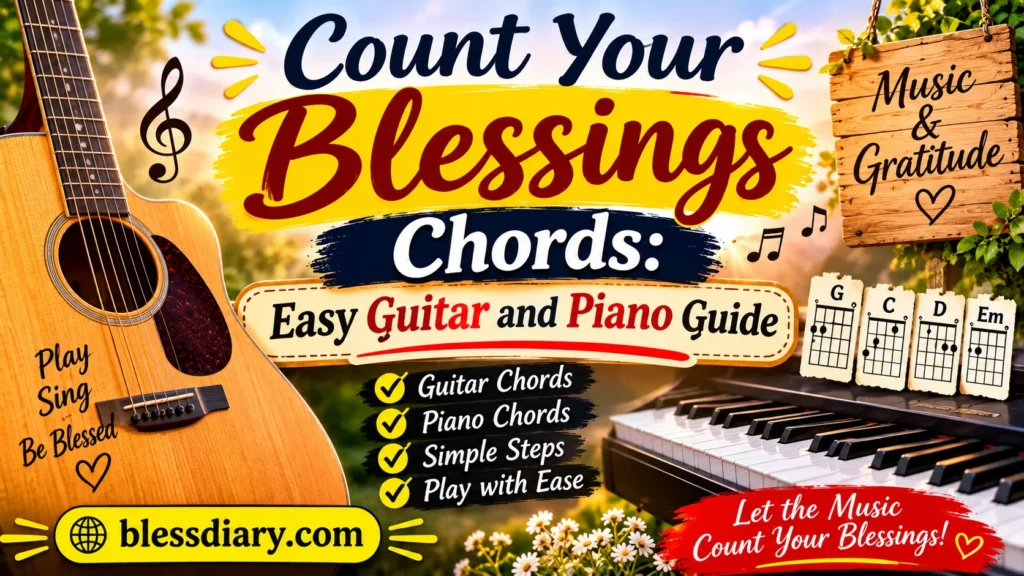
The easiest Count Your Blessings chords for beginner guitarists are G, C, D7, and G7. You can play this traditional Christian hymn in G major using a simple two-beat rhythm, while piano players can follow the same beginner arrangement or use the original E-flat major sheet music.
This complete guide covers the verse and chorus chord progressions, guitar chord notes, piano accompaniment, alternative keys, strumming patterns, and helpful playing tips. Whether you are preparing for Sunday worship, a church gathering, or a family sing-along, you can use these instructions to learn the hymn and accompany others confidently.
Quick Answer: What Are the Chords for Count Your Blessings?
For an easy G-major arrangement, the main Count Your Blessings chords are G, C, D7, and G7.
| Chord | Musical role | Notes |
|---|---|---|
| G | I (Tonic) | G – B – D |
| C | IV (Subdominant) | C – E – G |
| D7 | V7 (Dominant) | D – F# – A – C |
| G7 | Secondary dominant | G – B – D – F |
The basic chord progression uses G, D7, G7, and C to create a simple, familiar hymn accompaniment.
G is the home chord, D7 creates musical tension that resolves toward G, and G7 helps lead into C.
These chords provide a beginner-friendly starting point. Different hymnals and published arrangements may use additional chords or different placements, so follow your church’s sheet music when accuracy is important.
Count Your Blessings Verse Chords in G
The traditional hymn has four verses and a recurring refrain. The following is a simplified G-major chord arrangement for beginners.
| Musical phrase | Chord progression |
|---|---|
| Verse, line 1 | G – D7 |
| Verse, line 2 | G – G7 |
| Verse, line 3 | C – G |
| Verse, line 4 | D7 – G – D7 |
Hold each chord until the next harmonic change in your arrangement. You do not need to change chords every time the melody moves to another note.
Count Your Blessings Chorus Chords in G
The chorus uses a similar chord family, making it easier to learn after practising the verse.
| Musical phrase | Chord progression |
|---|---|
| Chorus, line 1 | G – D7 |
| Chorus, line 2 | G – D7 |
| Chorus, line 3 | G – G7 |
| Chorus, line 4 | C – G – D7 – G |
The final G chord provides a settled ending.
Note: This is a simplified accompaniment guide, not a complete transcription of the original four-part hymn score.
Which Count Your Blessings Song Is This?
Several songs share the title or phrase “Count Your Blessings.” Identifying the correct composition before practising is important because different songs have different melodies and chords.
This guide covers the traditional Christian hymn written by Johnson Oatman Jr., with music composed by Edwin O. Excell in 1897.
It is commonly recognized by its opening line, “When Upon Life’s Billows You Are Tempest-Tossed.” The hymn encourages Christians to remember God’s goodness and remain grateful through difficult circumstances.
The Traditional Christian Hymn
The traditional hymn has these historical details:
| Detail | Information |
|---|---|
| Title | Count Your Blessings |
| Lyricist | Johnson Oatman Jr. |
| Composer | Edwin O. Excell |
| Publication year | 1897 |
| Tune name | BLESSINGS |
| Original published key | E-flat major |
| Time signature | 2/4 |
| Structure | Four verses with a recurring refrain |
The hymn appeared in Songs for Young People in 1897 and became a familiar selection in Christian worship and thanksgiving gatherings. Hymnology Archive+1
Is It the Same as Counting My Blessings?
No. The traditional hymn is different from the modern Christian song “Counting My Blessings” by Seph Schlueter.
It is also different from “Count Your Blessings (Instead of Sheep),” the Christmas-film song written by Irving Berlin.
These are separate compositions with different lyrics, melodies, and chord progressions.
If your sheet music credits Johnson Oatman Jr. and Edwin O. Excell, you have the traditional hymn covered in this guide.
Original Key, Time Signature, and Music Details
The original published version of “Count Your Blessings” is in E-flat major and uses a 2/4 time signature.
Some modern chord charts transpose the hymn into G major or D major to make it easier to accompany on guitar and other instruments.
Here are the main musical details:
| Music detail | Traditional hymn information |
|---|---|
| Hymn title | Count Your Blessings |
| Words | Johnson Oatman Jr. |
| Music | Edwin O. Excell |
| First publication | 1897 |
| Original key | E-flat major |
| Time signature | 2/4 |
| Hymn meter | 11.11.11.11 with refrain |
| Structure | Four verses and chorus |
What Does 2/4 Time Mean?
A 2/4 time signature means that each measure contains two quarter-note beats.
Count the rhythm like this:
ONE – two | ONE – two
The first beat usually receives a little more emphasis than the second. This creates a steady, forward-moving rhythm suitable for accompanying congregational singing.
The original notation should not automatically be played as a three-beat waltz. If you are using a modern arrangement with a different meter, follow that particular score instead.
The original sheet music and historical hymn records support these musical details. piano.org+2
Count Your Blessings Chords by Key
You do not have to play the hymn in its original key. Transposing it into another key can make the melody more comfortable for singers and the chord shapes easier for beginners.
The following comparison table shows the basic chord families in five useful keys.
| Key | I chord | IV chord | V7 chord | Transition chord |
|---|---|---|---|---|
| G major | G | C | D7 | G7 |
| C major | C | F | G7 | C7 |
| D major | D | G | A7 | D7 |
| A major | A | D | E7 | A7 |
| E-flat major | E♭ | A♭ | B♭7 | E♭7 |
These are transposed chord families for simplified accompaniment, not complete transcriptions of every published arrangement.
G Major: An Easy Guitar Key
G major is a convenient choice for beginner guitarists because its main chords use familiar open-position shapes.
You need to learn:
- G major
- C major
- D7
- G7
Practise switching between G and C, then G and D7. Once these changes feel comfortable, add G7 to your practice.
If you can play these chords cleanly without stopping, you have the basic skills needed to accompany a simplified version of the hymn.
C Major: A Convenient Piano and Ukulele Key
C major is another beginner-friendly option.
Its basic chord family includes:
- C major
- F major
- G7
- C7
Piano beginners often find C major comfortable because its main triads use white keys.
Ukulele players can also use this key, although the F chord may require additional practice.
E-flat Major: The Original Published Key
E-flat major is the key used in the traditional published score.
Its primary chords are:
- E-flat major (E♭)
- A-flat major (A♭)
- B-flat seventh (B♭7)
For piano players, E-flat major uses three flats: B-flat, E-flat, and A-flat.
This is the appropriate starting point if you want to follow the original printed arrangement rather than a simplified guitar chart. piano.org+1
D and A Major: Alternative Options
D major and A major are useful alternatives when G major does not suit the singers.
D major uses D, G, and A7, while A major uses A, D, and E7.
Choose the key based on the vocal range of the people singing rather than assuming one key works for every congregation.
Count Your Blessings Guitar Chords
You can accompany the traditional hymn on an acoustic or electric guitar. For beginners, an acoustic guitar with standard tuning and open chords is a practical starting point.
How to Play G, C, D7, and G7
Here are the chord notes and basic playing instructions.
1. G Major
Notes: G – B – D
Place your fingers in a comfortable open G position. Make sure the strings that should ring are not accidentally muted.
2. C Major
Notes: C – E – G
Keep your fingertips curved and press close to the frets. Avoid touching neighboring strings.
3. D7
Notes: D – F# – A – C
D7 provides the dominant sound that helps lead back to G major.
4. G7
Notes: G – B – D – F
G7 introduces F natural, giving the chord a stronger pull toward C major.
Practise each chord individually before trying to play the entire hymn.
Easy Guitar Strumming Pattern
Because the traditional hymn is written in 2/4, begin with a simple two-beat strumming pattern.
Beginner pattern:
| Beat | Strumming direction |
|---|---|
| Beat 1 | Downstroke |
| Beat 2 | Downstroke |
Count:
ONE – two | ONE – two
Once you are comfortable, try a slightly fuller pattern:
- Beat 1: Downstroke.
- Beat 2: Light down-up movement.
Keep the rhythm even and avoid strumming too aggressively, especially when accompanying a congregation.
How to Use a Capo
A capo can help you change the sounding key without learning new chord shapes.
For example:
| Guitar chord shapes | Capo position | Sounding key |
|---|---|---|
| G shapes | No capo | G major |
| G shapes | 2nd fret | A major |
| G shapes | 3rd fret | B-flat major |
| G shapes | 5th fret | C major |
A capo raises the sounding pitch; it does not lower it. If singers need a lower key, transpose the chord progression downward instead.
Count Your Blessings Piano Chords
Piano players can use the same basic chord progression as guitarists.
The easiest approach is to play chord tones with the right hand and support them with bass notes in the left hand.
Right-Hand Piano Chord Positions
Start by learning these four basic chords in G major.
| Chord | Right-hand notes |
|---|---|
| G | G – B – D |
| C | C – E – G |
| D7 | D – F# – A – C |
| G7 | G – B – D – F |
Play the notes together as block chords.
You do not need advanced piano skills to accompany the hymn. Clear chord changes and steady timing are more important than complicated arrangements.
Left-Hand Bass Notes
The left hand provides the foundation for the harmony.
Begin with these root notes:
- G chord: Play G.
- C chord: Play C.
- D7 chord: Play D.
- G7 chord: Play G.
Play the bass note on the first beat of each measure.
When you feel comfortable, add the fifth above the root for a fuller sound. For example, play G and D together when accompanying a G chord.
Easy Two-Hand Piano Accompaniment
A simple beginner arrangement looks like this:
| Beat | Left hand | Right hand |
|---|---|---|
| Beat 1 | Chord root | Hold or play chord |
| Beat 2 | Optional fifth | Repeat or sustain chord |
Start slowly and practise each hand separately. Once both hands feel comfortable, combine them while keeping the two-beat pulse steady.
Playing the Original E-flat Arrangement
If you want to follow the original published key, learn these chord notes:
| Chord | Notes |
|---|---|
| E♭ | E♭ – G – B♭ |
| A♭ | A♭ – C – E♭ |
| B♭7 | B♭ – D – F – A♭ |
The original published score uses E-flat major. Its full harmony is more detailed than a basic three-chord accompaniment, so consult the actual notation if you want a faithful performance. piano.org
How to Choose the Best Key for Congregational Singing
The best key is the one that allows most people in the congregation to sing comfortably.
A guitarist might prefer G major because the chord shapes are easy, but that does not automatically make it the best vocal key.
Consider these points before choosing:
- Check the highest notes. Ask a singer to try the highest phrase. It should not feel strained.
- Check the lowest notes. The lower notes should remain comfortable and audible.
- Consider the congregation. Choose a key that works for the majority rather than one individual.
- Rehearse the refrain. The chorus is a useful section for checking the overall vocal range.
- Keep the arrangement consistent. Make sure everyone has the same key before the service begins.
If the melody feels too high, try transposing it down. If it feels too low, move it up.
The original E-flat version is not compulsory for every performance. A transposed version is perfectly suitable when it helps people sing together.
Common Chord and Rhythm Mistakes
Even a simple hymn can sound uncomfortable when the rhythm or chord changes are incorrect. Watch out for these common problems.
1. Using the Wrong Song’s Chords
Always check the lyricist and composer. The traditional hymn is different from modern songs with similar titles.
2. Assuming G Is the Original Key
G major is a beginner-friendly transposition. The traditional published score is in E-flat major.
3. Playing in 3/4 Time
The original hymn is in 2/4, not 3/4. Count two beats per measure when following the traditional notation.
4. Ignoring the G7 Transition
In the simplified G-major arrangement, G7 helps move the harmony toward C. Leaving it out may make the accompaniment sound less like the intended version.
5. Changing Chords Too Quickly
Do not change chords every time the melody moves to another note. Follow the harmonic changes in your arrangement.
6. Playing Too Loudly
A worship accompaniment should support the singing. Avoid excessive strumming or unnecessary piano fills that compete with the melody.
7. Choosing an Uncomfortable Key
If singers struggle to reach the high or low notes, consider transposing the song before the performance.
Where to Find Count Your Blessings Sheet Music
If you want a complete arrangement rather than a simplified chord guide, use a reliable hymnal or published sheet music source.
Here are some useful places to start:
- Piano.org: Provides an engraved version of the traditional hymn, with original key and time-signature information and piano sheet music.
- Hymnary: Provides historical tune and publication information, along with score resources. .
- Timeless Truths: Provides historical hymn information and score resources.
- Musicnotes: Offers licensed sheet music and transposed arrangements.
- WorshipChordBook: Provides a simplified G-major chord arrangement with verse and chorus placement.
Your church hymnal should remain the main reference if you are accompanying a congregation. Different editions can use different keys or harmonizations.
Is Count Your Blessings in the Public Domain?
The traditional words by Johnson Oatman Jr. and music by Edwin O. Excell were first published in 1897.
The original hymn is generally treated as public domain in the United States. However, a modern arrangement, recording, edited score, or newly created accompaniment may have separate copyright protection.
Check the rights information for the specific edition before reproducing or distributing it. Johnson Oatman, Jr.+1
Frequently Asked Questions
What are the basic chords for Count Your Blessings?
The basic chords for a simplified G-major arrangement are G, C, and D7. G7 is also useful for the transition into C. These chords provide a straightforward accompaniment for beginners.
What key was the original Count Your Blessings hymn written in?
The traditional published version was written in E-flat major. However, modern chord charts offer transposed versions in G, D, and other keys to accommodate different instruments and singers.
Is Count Your Blessings in 2/4 or 3/4 time?
The traditional published hymn uses 2/4 time. Each measure contains two quarter-note beats. A simple two-beat strumming pattern works well for this arrangement.
Can a beginner play Count Your Blessings on guitar?
Yes. Beginners can start with G, C, D7, and G7 in an easy G-major arrangement. Practise the chord transitions slowly and use simple downstrokes until you can maintain a steady rhythm.
Can I play Count Your Blessings on piano?
Yes. You can play the hymn using block chords in the right hand and bass notes in the left hand. Start with the G-major arrangement or use the original E-flat sheet music if you want to follow the traditional published version.
What are the easy ukulele chords for Count Your Blessings?
A simplified C-major version uses C, F, and G7, with C7 available for certain transitions. Check your chosen arrangement for the exact chord placement.
Is Count Your Blessings a public-domain hymn?
The original 1897 hymn by Johnson Oatman Jr. and Edwin O. Excell is generally considered public domain in the United States. Modern arrangements and recordings may have separate copyright restrictions.
Is Count Your Blessings the same as Counting My Blessings?
No. The traditional hymn written by Johnson Oatman Jr. and Edwin O. Excell is different from the modern Christian song “Counting My Blessings” by Seph Schlueter. They have different lyrics, melodies, and chord progressions.
How do I change the key if the hymn is too high to sing?
Use a transposing chart or a capo on the guitar to raise the sounding key. To lower the key, transpose the chord progression down. Choose a range that feels comfortable for the majority of singers.
DISCOVER MORE ARTICLES
Deuteronomy Blessings and Curses: Meaning and Lessons Today
Today’s Blessings Quotes: 45 Meaningful Words for Today
Marriage Blessings: Heartfelt Wishes, Prayers & Words

Shahzad is the Founder of BlessDiary, sharing Christian prayers, blessings, Bible-based encouragement, and inspiring messages to strengthen faith and bring hope to everyday life.