
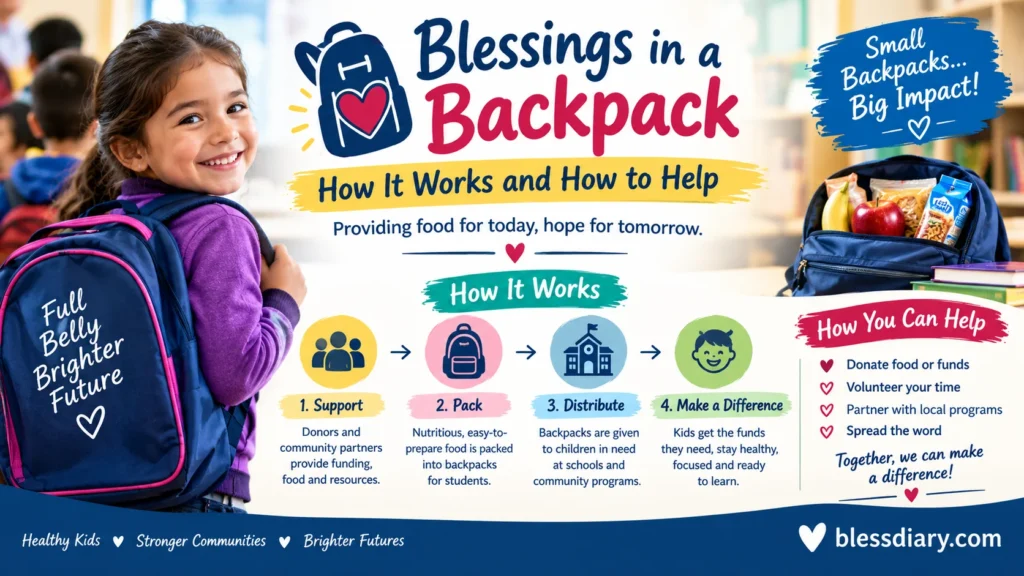
The phrase Blessings in a Backpack can refer to a nonprofit program that helps children facing weekend hunger, or to the tradition of blessing students and their school bags before a new academic year. Although these two ideas are different, both reflect the same spirit of care: helping children feel supported, prepared, and valued.
The U.S.-based nonprofit Blessings in a Backpack works with communities to provide food for school-aged children who might otherwise go hungry when school meals are unavailable over the weekend. Separately, families, churches, and schools may hold backpack blessing ceremonies to pray for students, encourage them, and ask for God’s guidance throughout the school year.
This guide explains what the nonprofit does, how its weekend food program works, how to donate or volunteer, and what communities should consider when starting a program. It also includes original backpack blessings and prayers that parents, teachers, and church leaders can share with children.
What Is Blessings in a Backpack?
Blessings in a Backpack is a U.S. nonprofit organization that mobilizes communities, volunteers, and resources to provide weekend food for school-aged children who might otherwise experience hunger. Its goal is to help children have the nourishment they need to learn and grow.
The need behind the program is straightforward. Some children receive breakfast and lunch at school during the week but have limited access to food when school closes for the weekend. A dependable source of food can help bridge that gap.
The organization began in 2005 when Missy Hammerstrom, who was volunteering at an elementary school in Louisville, Kentucky, learned that a child wanted to take her apple home to eat over the weekend. That moment inspired Missy to buy backpacks, fill them with food, and help feed 30 children. The organization became a registered 501(c)(3) charitable nonprofit in 2008.
Today, the program connects community support with a practical need: helping children access food outside school hours.
It is important to distinguish the nonprofit from a blessing of the backpacks ceremony. The nonprofit focuses on weekend food assistance, while a backpack blessing is a prayer or encouraging message offered to students, often before school begins. A family or church can participate in a backpack blessing without being affiliated with the nonprofit.
How Does the Blessings in a Backpack Program Work?
The program brings together schools, community partners, donors, and volunteers. Specific arrangements vary by location, so anyone interested in participating should confirm the process with the local program.
A typical weekend food program may involve the following steps:
- Identifying children who need support. School staff and program coordinators work to determine which students may benefit from weekend food assistance while respecting family privacy.
- Organizing local support. Volunteers, donors, community organizations, and other partners help provide the resources needed to run the program.
- Selecting appropriate food. Food is chosen according to the program’s current guidelines, children’s needs, and practical considerations such as packaging and preparation.
- Packing food bags. Volunteers prepare the packages according to the approved food list and distribution plan.
- Distributing food discreetly. The school and program team arrange distribution in a way that protects children’s dignity and avoids drawing unnecessary attention to individual recipients.
- Maintaining consistent support. Ongoing funding, volunteers, and coordination help the program continue throughout the school year.
The exact process is not identical everywhere. Some programs may have specific packing schedules, approved donation lists, or school-based procedures. Check with the relevant chapter before assuming that a particular arrangement applies to your community.
What Goes in a Backpack Food Bag?
The contents depend on the local program’s guidelines, budget, and the needs of participating children. Examples of foods that may be suitable include:
- Single-serving cereal or oatmeal.
- Shelf-stable milk or other approved drinks.
- Fruit cups or fruit pouches.
- Easy-to-open protein foods.
- Crackers and other suitable snacks.
- Simple meals that require little preparation.
These are examples, not a universal shopping list. Always check the current requirements before purchasing or donating food.
Food should be unopened, within its use-by or best-before guidance, and stored according to the manufacturer’s instructions. Programs should also consider allergies, dietary restrictions, package accessibility, and whether a child can safely prepare the food available to them.
A donation is most useful when it meets an identified need rather than adding extra sorting work for volunteers.
Why Weekend Food Assistance Matters
School meals can be an important source of nourishment for children. However, children who depend on those meals may face a gap when school is closed.
Weekend hunger is not always obvious. A child may arrive at school looking tired, have difficulty concentrating, or worry about whether there will be enough food at home. These signs alone do not establish that a child is experiencing food insecurity, but they can remind adults to respond with care and appropriate support.
Food assistance can help families manage a difficult part of the week and give children more opportunity to focus on learning, friendships, and everyday activities.
It is equally important to recognize that families experiencing food insecurity may be working hard and managing circumstances beyond their control. A temporary financial setback, rising household expenses, or an unexpected change in employment can affect a family’s ability to afford groceries.
A weekend food program does not solve every cause of hunger, and it should not replace broader efforts to improve access to nutritious food. It can, however, provide practical support during a period when some children have fewer options.
The guiding principle is simple: children should receive help without being made to feel ashamed of needing it.
How to Help Blessings in a Backpack
You do not need to organize a large fundraiser or make a substantial donation to contribute. The right way to help depends on what your local program needs and what you can reasonably offer.
1. Make a Financial Donation
Financial donations allow the organization or local program to direct funds toward approved needs.
The official website currently states that, on average, $175 can feed one child on weekends for a 36-week school year through the program. This is an organizational estimate, not a guarantee that every local program has identical costs. Check the official website for current details before making a donation decision.
You can visit the official Blessings in a Backpack website to explore donation options.
If you wish to support a particular school or community, check whether the donation can be directed to that program. Keep your giving within your budget; a small, sustainable contribution is more practical than a commitment you cannot maintain.
2. Donate Food From an Approved List
Food donations can be useful when a local coordinator has requested specific items.
Before shopping, ask which products are accepted, what package sizes are needed, and whether the program has allergy or dietary guidelines. Avoid donating opened packages, expired food, or products that require equipment or preparation the intended recipient may not have.
If the program currently needs a particular item, purchasing that item is often more helpful than supplying a mixture of unrelated groceries.
3. Volunteer Your Time
Volunteers may be able to help with packing, organizing supplies, preparing approved food donations, or supporting fundraising activities.
To get started, find a local program through the organization’s official website and ask about available opportunities. Confirm the location, schedule, age requirements, registration process, and any screening or training needed.
Families, students, coworkers, and community groups may be able to participate together, depending on local arrangements.
Even occasional volunteering can help when it meets a real need and fits the program’s schedule.
4. Organize a School or Community Food Drive
A food drive can bring people together around a clear and achievable goal.
For example, a school group could collect a requested list of shelf-stable foods over two weeks. A church could invite members to contribute approved items during a community event. A workplace could organize a donation campaign and share the results with participants.
Before launching the drive:
- Contact the local program and confirm what is needed.
- Set a realistic collection period and goal.
- Share the approved list clearly.
- Arrange safe storage and delivery.
- Explain how donated items will be used.
- Protect the privacy of children and families receiving assistance.
A smaller drive that provides exactly what a program needs may be more useful than a large collection of unsuitable items.
5. Ask Your School or Church About Local Needs
If you are unsure where to begin, speak with a school administrator, counselor, community leader, or church outreach coordinator.
Ask whether a weekend food program already exists, whether another local organization provides similar assistance, and what support is currently needed.
You may discover that the best contribution is not starting a new initiative but helping an existing program reach more children.
How to Start a Blessings in a Backpack Program
Starting a weekend food program requires more than collecting groceries. It involves school cooperation, dependable funding, appropriate food choices, safe handling, and a respectful distribution process.
If you want to establish a program in your community, begin by contacting the national organization through its official website. Ask about its current requirements, program models, and process for establishing a local initiative.
These steps can help you prepare.
Step 1: Talk to a potential school partner.
Begin with a school administrator or another appropriate staff member who understands the school’s needs. Discuss whether weekend food assistance would be useful and how eligible children could be identified discreetly.
Step 2: Find a reliable community partner.
A church, civic group, business, parent association, or other community organization may be able to contribute funding, volunteers, storage, or coordination. Confirm the partner’s responsibilities before making commitments.
Step 3: Prepare a realistic budget.
Estimate the number of children to be served, the length of the program, food costs, packaging, transportation, and other necessary expenses. Identify likely funding sources and plan for what happens if donations fall short.
Step 4: Establish food and safety procedures.
Use the organization’s current guidance and any applicable school or local requirements. Consider allergies, dietary needs, food storage, expiration dates, packaging, and the age of the children receiving the food.
Step 5: Create a reliable volunteer schedule.
Assign responsibilities for purchasing, packing, inventory, delivery, and communication. Make sure each task has a responsible person and a backup plan.
Step 6: Protect children’s privacy.
Agree with the school on how food will be distributed without embarrassing or identifying recipients. Obtain appropriate permission before taking or sharing any photographs, and never publish sensitive information about a child’s circumstances.
Step 7: Plan for school holidays and interruptions.
Ask how the program will handle longer school breaks, unexpected closures, changes in enrollment, and shortages of supplies. Continuity is easier to maintain when these issues are considered early.
Step 8: Review the program regularly.
Check whether the food provided is useful, whether distribution is working smoothly, and whether funding and volunteer arrangements remain sustainable. Use appropriate feedback to make improvements while respecting family confidentiality.
A thoughtful, manageable program is a stronger starting point than an ambitious plan without enough resources to continue.
Blessings of the Backpacks: Short Messages to Share
A blessing of the backpacks is a separate tradition in which students receive a prayer or encouraging message before the school year or another important stage of learning.
These original messages are suitable for a parent, teacher, church leader, or family member to share with a child. They are devotional or encouraging words, not quotations from the Bible.
Short Back-to-School Blessings
- May your backpack carry the tools for learning and your heart carry the courage to try.
- May kindness meet you in the classroom and friendship find you along the way.
- May you discover something new, ask thoughtful questions, and grow a little every day.
- May your school days bring opportunities to learn, laugh, and help others.
- May you remember that mistakes are part of learning and that asking for help is a sign of courage.
- May you feel welcomed, respected, and encouraged wherever your school day takes you.
Backpack Blessings for the First Day of School
- May you walk into your new classroom with courage, even if you feel nervous.
- May a friendly face help you feel at home, and may you find the confidence to be yourself.
- May this first day open the door to new friendships, useful lessons, and happy memories.
- May you remember that you do not have to know everything on the first day; you only need to be willing to learn.
- May your worries become smaller as your confidence grows, one school day at a time.
Christian Back-to-School Blessings
- May God guide your steps, strengthen your heart, and help you treat others with love and patience.
- May the Lord give you wisdom when lessons are difficult and courage when you face something new.
- May God’s peace comfort you when you feel anxious, and may His love remind you that you are never without hope.
- May your words be kind, your choices be wise, and your heart remain open to learning.
- May God bless your teachers, protect your journey, and help you use your gifts to serve others.
A Parent’s Blessing for a Child’s Backpack
May this backpack remind you that you are loved before the school day begins and after it ends. May you have the courage to try, the patience to learn, and the kindness to include others. When something feels difficult, remember that you can ask for help. When something goes well, remember to be thankful. Go into your day knowing that you are precious, capable of growing, and surrounded by people who want to see you thrive.
A Simple Christian Prayer for a Backpack Blessing
This is an original Christian devotional prayer, not a direct quotation from Scripture.
Heavenly Father, thank You for the gift of this child and the opportunity to learn. Please grant wisdom to this student, patience to their teachers, and understanding to everyone who supports their education.
When the day feels difficult, give this child courage to keep trying and confidence to ask for help. Help them choose kindness, respect others, and remember that their worth is not measured by grades or achievements.
Please guide their journey to and from school, comfort them when they feel worried, and surround them with caring people. May this school year bring growth, meaningful friendships, and opportunities to use their gifts well.
In Jesus’ name, Amen.
A Short Prayer for a School Assembly
Dear God, thank You for our students, teachers, families, and school community. Give us wisdom to learn, patience to grow, and kindness to care for one another. Help every child feel safe, respected, and encouraged. Guide us through the year ahead and teach us to use what we learn for good. In Jesus’ name, Amen.
Notes to Put Inside a Child’s Backpack
A short note tucked into a lunchbox or backpack can encourage a child without adding pressure. Choose words that match the child’s age, personality, and circumstances.
Encouraging Notes for School
- I am proud of the effort you put into learning.
- You do not have to be perfect to make progress.
- Your questions matter. Keep being curious.
- One difficult lesson does not define your whole day.
- You can be kind and still speak up when something is wrong.
- Remember to take a breath when you feel overwhelmed.
- I hope you find something interesting to learn today.
- You are loved on your best days and your hardest days.
For a child who is nervous about school, a reassuring note may be more helpful than one that focuses only on achievement. For a child who is struggling, remind them that asking a teacher for help is a sensible step.
If you volunteer with a weekend food program and want to include notes in food bags, ask the coordinator first. Follow the program’s rules and avoid including personal information, religious messages that recipients have not requested, or anything that could identify a child publicly.
Mistakes to Avoid When Supporting a Backpack Program
Good intentions are important, but practical decisions determine whether help reaches children effectively.
Donating without checking requirements: Ask for the approved food list before buying supplies. Unrequested items may be unsuitable or difficult to distribute.
Ignoring dietary needs: Food allergies, cultural preferences, dietary restrictions, and accessibility needs should be considered through the program’s established procedures.
Sharing photographs without permission: Never assume that a child’s participation in a food program gives you permission to photograph or identify them. Follow the organization’s and school’s privacy policies.
Promising more than you can provide: A donation or volunteer commitment should fit your resources. Sustainable support is more useful than a large promise that cannot be maintained.
Assuming every local program works the same way: Requirements, schedules, food packages, and volunteer arrangements may differ. Check the current guidance for the specific program you wish to support.
Using language that creates shame: Speak about food insecurity respectfully. Families who need assistance deserve dignity, privacy, and the same consideration as everyone else.
Confusing a backpack blessing with food assistance: A prayer ceremony may encourage students, but it does not provide food to a hungry child. Both forms of support can be valuable, and they serve different purposes.
Frequently Asked Questions About Blessings in a Backpack
What does Blessings in a Backpack do?
Blessings in a Backpack is a U.S. nonprofit that mobilizes communities and volunteers to provide weekend food for school-aged children who might otherwise go hungry. Local arrangements vary by program.
Who founded Blessings in a Backpack?
Missy Hammerstrom started the initiative in Louisville, Kentucky, in 2005 after learning that a child wanted to take food home for the weekend. The organization became a 501(c)(3) nonprofit in 2008.
How can I donate to Blessings in a Backpack?
Visit the official website at https://www.blessingsinabackpack.org/ to explore donation options. If you want to support a particular local program, ask whether your contribution can be directed to it.
Can I donate food instead of money?
Possibly, depending on the local program’s requirements. Contact the coordinator before purchasing food and ask for the current list of accepted items, packaging requirements, and any dietary or safety guidelines.
How can I volunteer with Blessings in a Backpack?
Start by visiting the official website to locate a program or chapter. Ask about packing opportunities, fundraising, supply organization, and any registration or screening requirements.
Is Blessings in a Backpack a religious organization?
The national organization describes its mission as mobilizing communities and resources to provide weekend food for school-aged children. Churches may participate as community partners, but a backpack blessing ceremony is a separate practice. Consult the organization’s official materials for its current policies and program structure.
What is a blessing of the backpacks?
A blessing of the backpacks is a ceremony or personal prayer that asks for guidance, safety, wisdom, and encouragement for students as they begin or continue their education. It may take place at a church, school, or home.
What should I say during a backpack blessing?
Keep the words warm and age-appropriate. You might ask God to guide the child, help them learn, encourage kindness, and give them courage when school feels difficult. A blessing can be brief and sincere.
Can I organize a weekend food program at my school?
Yes, you can explore the possibility by contacting the national organization and a potential school partner. Discuss the need, funding, food requirements, distribution procedures, volunteer responsibilities, and privacy safeguards before launching a program.
How much does it cost to feed a child through the program?
The organization’s official website currently estimates an average of $175 to feed one child on weekends for a 36-week school year. Costs and program arrangements may change, so check the latest information directly with the organization.
Can I share backpack blessings with children who are not part of the nonprofit?
Yes. Original blessings, encouraging notes, and Christian prayers can be shared with children independently of the food program. If you are including notes in food bags distributed through an organized program, ask the coordinator for permission and follow its guidelines.
A Final Thought: Small Acts of Care Can Make a Difference
Blessings in a Backpack shows how community action can respond to a practical need. Donors can help fund food, volunteers can contribute their time, and schools and community partners can help coordinate support for children who need it.
A backpack blessing offers another kind of encouragement. A parent’s prayer, a teacher’s kind words, or a thoughtful note can remind a child that learning is a journey and that asking for help is nothing to be ashamed of.
These efforts serve different purposes, but both begin with the same intention: to help children feel supported and give them a better opportunity to learn, grow, and thrive.
Whether you choose to donate, volunteer, organize a food drive, or share a blessing before the first school bell rings, start with what is genuinely needed. Respect the people you hope to help, keep your commitments realistic, and remember that consistent care often matters more than a grand gesture.
DISCOVER MORE ARTICLES
Blessings OBGYN: Services, Location, Hours & Appointments
Tuesday Blessings and Prayers Images to Share Hope and Faith
Short Friday Blessings Quotes: 75+ Beautiful Wishes to Share

Shahzad is the Founder of BlessDiary, sharing Christian prayers, blessings, Bible-based encouragement, and inspiring messages to strengthen faith and bring hope to everyday life.