
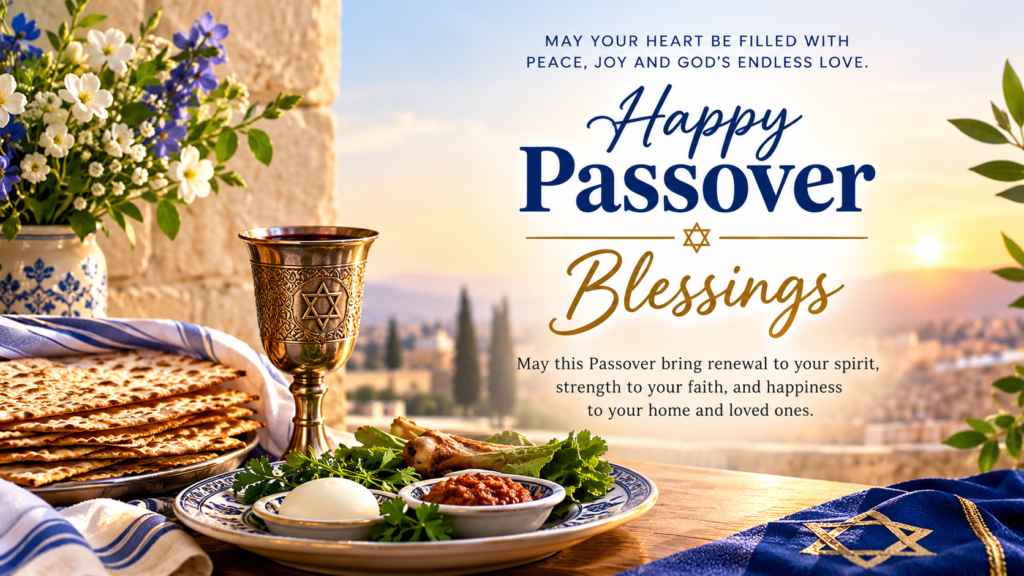
Walk into any Seder and you’ll notice the same thing: the room goes quiet right before someone lights a candle or lifts a cup. Those pauses are the blessings. Some are sung from memory, some are read off a printed page by people trying not to trip over the Hebrew, and all of them count.
This guide puts the Passover blessings in the order you’ll meet them, with the Hebrew in transliteration and a plain-English meaning for each. After the ritual part comes the other half of the question: what to actually say to a friend, a host, or a grandparent. You’ll find greetings, short wishes, and a few conversations that sound like real life.
Question: What are the main Passover blessings?
Answer: The main ones are the candle blessing, the Shehecheyanu, the Kiddush over wine, and the blessings over the green vegetable (karpas), matzah, and bitter herbs (maror). Many families also say a blessing for removing leaven the night before and bless their children before the Seder begins.
Do You Have to Say Them in Hebrew?
No. Hebrew is traditional and many families keep it, but a blessing said in English is still a blessing. Most Haggadot print the Hebrew, the transliteration, and the English side by side so the whole table can join in.
If you’re nervous about a first Seder, here’s a shortcut: learn three. The candles, the wine, and the matzah. Everything else can be read from the page.
Passover Blessings in Order
| When | Blessing | What it marks |
|---|---|---|
| The night before | Removing leaven (chametz) | Searching for and clearing out leavened food |
| Seder night | Candle lighting | Welcoming the festival |
| Seder night | Blessing the children | Passing the tradition down |
| Opening of the Seder | Kiddush and Shehecheyanu | Sanctifying the day over the first cup |
| Karpas | Fruit of the earth | Dipping the green vegetable in salt water |
| Matzah | Hamotzi and the matzah blessing | Two blessings before eating |
| Maror | Bitter herbs | Remembering the bitterness of slavery |
| After the meal | Grace after meals | Thanking God for the food |
Customs differ between Ashkenazi, Sephardi, Mizrahi, Reform, Conservative, and Orthodox homes, in wording, melody, and sometimes order. If you’re a guest, follow your host.
The Night Before: Removing Leaven
This is the blessing most lists skip. The evening before Passover, many families search the house for leftover chametz by candlelight, often with a feather and a wooden spoon. Kids tend to love it, mostly because the crumbs were hidden on purpose.
Baruch atah Adonai, Eloheinu melech ha’olam, asher kid’shanu b’mitzvotav v’tzivanu al biur chametz.
Meaning: Blessed are You, Lord our God, Ruler of the universe, who has made us holy through Your commandments and commanded us concerning the removal of leaven.
Lighting the Festival Candles
Candles mark the moment the holiday begins. Traditionally the woman of the house lights them, but any adult can.
Baruch atah Adonai, Eloheinu melech ha’olam, asher kid’shanu b’mitzvotav v’tzivanu l’hadlik ner shel Yom Tov.
Meaning: Blessed are You… who commanded us to kindle the festival light.
When the Seder falls on a Friday night, the words add Shabbat: l’hadlik ner shel Shabbat v’shel Yom Tov. On the second night, many communities light after nightfall from an existing flame.
Shehecheyanu
This is the blessing for new and special moments. It’s said at candle lighting and again during Kiddush.
Baruch atah Adonai, Eloheinu melech ha’olam, shehecheyanu v’kiy’manu v’higi’anu laz’man hazeh.
Meaning: Blessed are You… who has kept us alive, sustained us, and brought us to this season.
Question: What does the Shehecheyanu mean?
Answer: It thanks God for keeping us alive and bringing us to a special moment. On Passover it’s said at the start of the holiday, at candle lighting and during Kiddush, and again on the second night in communities that hold two Seders.
Blessing the Children
Blessing children is a Shabbat and holiday tradition, and many families do it on Seder night before sitting down. The traditional wording:
- For boys: Y’simcha Elohim k’Efrayim v’chi’Menashe. (May God make you like Ephraim and Manasseh.)
- For girls: Y’simech Elohim k’Sarah, Rivka, Rachel v’Leah. (May God make you like Sarah, Rebecca, Rachel, and Leah.)
- For everyone: Yevarech’cha Adonai v’yishm’recha. (May God bless you and guard you.)
Many parents add a sentence of their own, and that’s usually the part kids remember. Something like: “I love how many questions you ask. Please never stop.”
Kiddush: The Blessing Over the Wine
Kiddush sanctifies the day over the first cup. The text changes with the day of the week: one version for Sunday through Thursday nights, one for Friday night when Shabbat and Passover arrive together, and one for Saturday night when Shabbat is bid farewell as Passover begins.
The weekday version closes with:
Baruch atah Adonai, m’kadesh Yisrael v’hazmanim. (Blessed are You, who sanctifies Israel and the festivals.)
And the wine blessing itself, which is repeated over the cups:
Baruch atah Adonai, Eloheinu melech ha’olam, borei p’ri hagafen.
Meaning: Blessed are You… Creator of the fruit of the vine.
A good Haggadah prints the right Kiddush for your night, so you don’t need to memorize the variations. Grape juice works just as well as wine.
The four cups are traditionally linked to four promises of redemption in the book of Exodus, which is why the Seder keeps returning to the cup.
Karpas, Matzah, and Maror
Karpas is a green vegetable, usually parsley or celery, dipped in salt water that stands for tears.
Baruch atah Adonai, Eloheinu melech ha’olam, borei p’ri ha’adama. Blessed are You… Creator of the fruit of the earth.
Matzah gets two blessings: the everyday one over bread, then one just for the holiday.
…hamotzi lechem min ha’aretz. (who brings forth bread from the earth.) …asher kid’shanu b’mitzvotav v’tzivanu al achilat matzah. (who commanded us concerning the eating of matzah.)
Maror is horseradish or romaine, eaten to remember bitterness. Expect a few watering eyes.
…asher kid’shanu b’mitzvotav v’tzivanu al achilat maror. Who commanded us concerning the eating of bitter herbs.
Question: What blessings are said over matzah at the Seder?
Answer: Two. First is Hamotzi, the regular blessing over bread. Second is “al achilat matzah,” the special blessing for the commandment to eat matzah on Passover. Both are said before eating.
After the Meal
The meal ends with the Grace after Meals (Birkat HaMazon), which thanks God for the food, the land, and Jerusalem. It’s long, so many families sing it from a booklet or use a shortened version. It’s also usually when the hunt for the afikomen gets serious.
The Rest of the Week
The Seder gets most of the attention, but Passover goes on. The first and last days of the holiday are festival days, and candle lighting and Kiddush return on those evenings. The Shehecheyanu is generally said at the start of the holiday rather than on the last days. The special matzah blessing is mainly for the Seder, while ordinary food blessings continue as usual on the days between.
Practices on the intermediate and final days vary more than the Seder does. If you want exact details, ask your rabbi or follow your community’s calendar.
“The 7 Blessings of Passover”: A Claim Worth Checking
If you’ve searched this topic, you may have landed on pages promising “seven blessings of Passover,” such as prosperity, protection, and health, tied to a financial “Passover offering.” That idea is not part of Jewish tradition or the Haggadah. Even Christian Bible teachers have pointed out that the chapter these claims draw on, Exodus 23, mentions neither Passover nor offerings.
You don’t pay anything to observe Passover or to receive a blessing. If a page links Passover blessings to a donation, be careful.
Passover Greetings: What to Say
Outside the Seder, the question is simpler: what do you say to people?
- Chag Pesach sameach (khag PEH-sakh sah-MAY-akh): “Happy Passover holiday.” The standard, safe choice.
- Chag sameach: “Happy holiday.” Works for any Jewish festival.
- Pesach kasher v’sameach: “A kosher and joyful Passover.” Good for observant friends.
- A zissen Pesach (Yiddish): “A sweet Passover.” Often heard from older relatives.
- Moadim l’simcha: “Times of joy,” common on the days between. The traditional reply is Chagim u’zmanim l’sasson.
- Happy Passover: perfectly fine in English.
Question: What do you say to someone on Passover?
Answer: “Chag Pesach sameach” (Happy Passover holiday) is the most common greeting, and “Happy Passover” is just as welcome. For observant friends, “Pesach kasher v’sameach” wishes them a kosher and joyful holiday. Avoid “Happy Easter,” which is a different holiday.
Short Wishes for Cards and Texts
- May your afikomen be well hidden and your kids’ negotiating skills modest.
- Chag Pesach sameach. Thinking of your table tonight.
- May the questions at your Seder be good ones.
- Wishing you brisket that’s tender and matzah that isn’t a brick.
- I’m eating matzah alone in my apartment and thinking of your mother’s cooking. Chag sameach.
- May whatever feels narrow right now start to widen.
- Save me a seat, even if it’s just in your heart this year.
Wishes for Specific People
The host: Thank you for the cooking, the cleaning, and keeping forty relatives on schedule. I hope you get to sit down for at least one full cup.
Grandparents: I still hear your voice in the songs every year. I hope we’re singing them together for a long time.
A friend hosting alone: A small table still counts. May this Seder feel quiet in the good way, and may next year’s be fuller.
Someone in a hard season: Passover is the holiday of getting through. May you feel carried until the narrow place opens.
An interfaith couple: May your first Seders together turn into stories you tell for years, and may both families find a place at the table.
A coworker: Wishing you and your family a peaceful and meaningful Passover. Please ignore your inbox this week.
Real Conversations
The family group chat, two days before
Miriam: Who’s bringing the horseradish?
Dalia: I thought you were.
Miriam: I thought you were.
Dalia: …I’ll stop at the store. Chag sameach, by the way.
Miriam: Chag sameach. Get extra salt for the water.
In the office hallway
Karen: Are you off Monday?
Imran: Monday and Tuesday. It’s Passover.
Karen: Oh, I should’ve known. Happy Passover.
Imran: Thanks, Karen. That’s kind of you to say.
A phone call with Grandma
Eli: Okay, I’ve got the candles. What do I say?
Grandma Ruth: Take your time. Baruch atah Adonai…
Eli: Baruch atah Adonai…
Grandma Ruth: There you go. You’re doing it better than your father did.
After the Seder, a guest at the door
Jonah: Thank you for having me. I didn’t know a single word.
Ruth: You said “amen” in all the right places.
Jonah: That’s the only thing I knew.
Ruth: That’s plenty. Come back next year.
If You’re a Guest at a Seder
Arrive on time and ask the host what to bring, since kosher-for-Passover rules rule out bread, pasta, and anything leavened. Say “Chag sameach” at the door. During the blessings, listen quietly and say “amen” at the end. If someone asks you to read a paragraph, nobody expects perfect Hebrew, or any Hebrew at all.
Frequently Asked Questions
What do you say at the start of a Seder?
The candles come first, then the blessing of the children if your family does it, then Kiddush over the first cup of wine.
How do you say Happy Passover in Hebrew?
“Chag Pesach sameach.” For an observant friend, “Pesach kasher v’sameach” is a good choice.
Can non-Jews say Passover blessings?
You can offer warm wishes. As a Seder guest you’re welcome to say “amen” and join in the songs. The formal blessings are generally led by Jewish participants.
What is said at the end of the Seder?
“L’shanah haba’ah b’Yerushalayim,” next year in Jerusalem, a hope for peace and freedom in the year ahead.
Are the “7 blessings of Passover” real?
Not as part of Jewish practice. The phrase is used by some ministries to request donations and has no basis in the traditional Haggadah.
Which Kiddush do I use if the Seder falls on Shabbat?
There are separate versions for Friday night and Saturday night. Check your Haggadah, which should print the right one.
DISCOVER MORE ARTICLES
Cute Thursday Blessings to Brighten Your Day 2026
50 Beautiful Wednesday Greetings and Blessings to Share 2026
Friday Weekend Blessings to Start Your Weekend With Joy 2026

Shahzad is the Founder of BlessDiary, sharing Christian prayers, blessings, Bible-based encouragement, and inspiring messages to strengthen faith and bring hope to everyday life.