
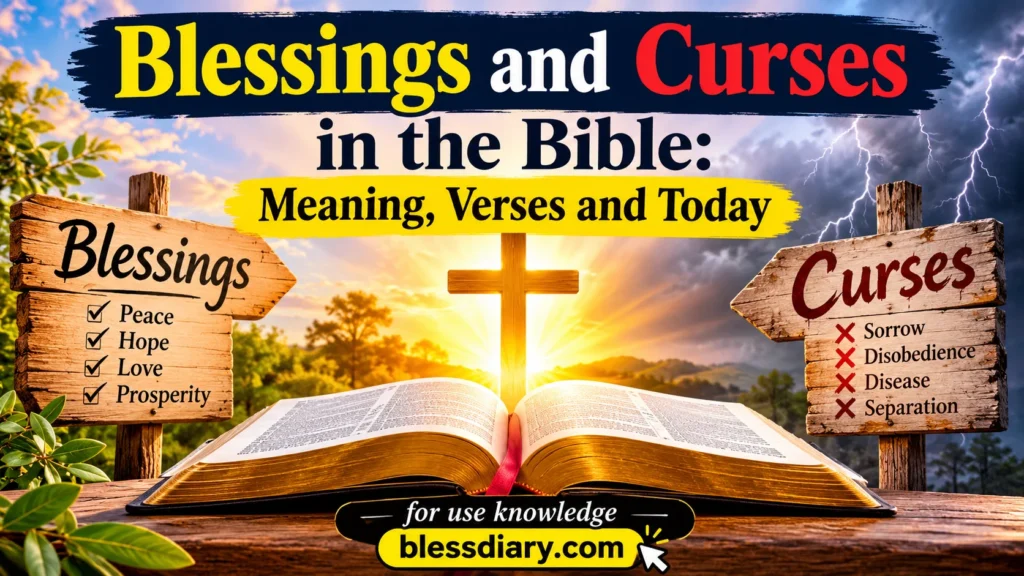
Blessings and curses in the Bible describe two very different outcomes: God’s favor and life-giving goodness, and the judgment or consequences associated with sin and covenant unfaithfulness. From Genesis to the teachings of Jesus and Paul, Scripture explains what these ideas mean, where they appear, and how Christians should understand them today.
The clearest Old Testament list appears in Deuteronomy 28, but the subject begins in Genesis and reaches an important turning point in the New Testament. Understanding that larger story helps readers approach difficult passages without confusing Israel’s covenant promises with a guarantee that every faithful person will have an easy or prosperous life.
What Do Blessings and Curses Mean in the Bible?
In the Bible, a blessing represents God’s goodness, favor, protection, and provision. A curse describes judgment or consequences associated with sin, rebellion, or covenant unfaithfulness. Both themes appear throughout Scripture, from the creation account in Genesis to the teachings of Jesus in the New Testament.
Understanding their biblical meaning requires looking at the context in which each passage was written.
What Is a Biblical Blessing?
A biblical blessing is an expression or gift of God’s goodness. It can include life, fruitfulness, protection, peace, wisdom, spiritual joy, or the privilege of living in a relationship with Him.
For example, God blessed humanity in Genesis 1:28 and instructed Adam and Eve to be fruitful and multiply. Later, He promised Abraham that all families of the earth would be blessed through him (Genesis 12:1–3).
Blessings are not limited to money, possessions, or material success. Jesus describes the poor in spirit, the meek, the merciful, and those who mourn as blessed in Matthew 5:3–12.
This shows that biblical blessing also involves spiritual growth, God’s presence, mercy, and the hope of His kingdom.
What Is a Biblical Curse?
A biblical curse is a declaration of judgment or a consequence connected with wrongdoing, rebellion, or broken covenant faithfulness.
In Genesis 3, the serpent and the ground are cursed following Adam and Eve’s disobedience. In Deuteronomy 28, Moses describes the consequences Israel would experience if the nation turned away from God’s commandments.
A biblical curse should not be understood as a magical spell or an independent force that can overpower God. Scripture presents curses within the context of God’s authority, justice, and judgment.
Blessing vs. Curse: Key Differences
| Point of comparison | Biblical blessing | Biblical curse |
|---|---|---|
| Basic meaning | God’s goodness and favor | Judgment and consequences |
| Common themes | Life, peace, protection, fruitfulness | Loss, hardship, judgment, exile |
| Old Testament examples | Genesis 12:1–3; Numbers 6:24–26 | Genesis 3:14–19; Deuteronomy 28 |
| Spiritual meaning | God’s goodness and relationship with His people | Consequences of rebellion and unfaithfulness |
| New Testament direction | Bless others and follow Christ | Do not repay evil with curses |
The main difference is that blessings reflect God’s goodness, while curses in biblical passages often describe the consequences of sin and disobedience.
Blessings and Curses in Genesis
Genesis introduces blessings and curses before Israel receives the law. Its opening chapters show that blessing is part of God’s purpose for creation, while curses and painful consequences enter the story through human rebellion.
God’s Blessing at Creation
The first blessings appear in Genesis 1.
God blesses the creatures of the sea and sky and then blesses humanity, telling them to be fruitful and multiply.
Genesis 1:28 (KJV) says:
“Be fruitful, and multiply, and replenish the earth, and subdue it.”
This blessing establishes humanity’s responsibility to care for creation and participate in the work God entrusted to them.
It also shows that blessing was part of God’s original purpose. It was not first introduced as something people had to earn through religious performance.
The Fall and the First Curses
The first curses appear after Adam and Eve disobey God in the Garden of Eden.
In Genesis 3:14–19, God pronounces a curse on the serpent and the ground. The passage describes painful consequences, including hardship, conflict, difficult labor, and mortality.
One important detail is that the text explicitly identifies the serpent and the ground as cursed. It describes the consequences experienced by Adam and Eve without using the same wording to say that both humans themselves were cursed.
Cain also experiences judgment after murdering his brother Abel.
Genesis 4:11 describes Cain as cursed from the ground because of his actions. Yet God places a protective mark on him to prevent others from killing him (Genesis 4:15).
This account shows that biblical judgment and mercy can appear together.
Abraham’s Blessing and God’s Promise
One of the most important blessings in the Bible appears in Genesis 12:1–3.
God calls Abraham to leave his country and promises to make him a great nation. He also promises that all families of the earth will be blessed through him.
Genesis 12:3 (KJV) says:
“And in thee shall all families of the earth be blessed.”
This promise becomes foundational to the Bible’s larger story. It shows that God’s purpose was not limited to one individual or family. His promise to Abraham pointed toward blessing reaching the nations.
The New Testament later connects this promise with Jesus Christ and the blessing offered through faith (Galatians 3:8–14).
Jacob, Isaac and the Meaning of a Spoken Blessing
Genesis 27 describes how Jacob receives Isaac’s blessing through deception.
In that family setting, a father’s spoken blessing carried significant importance. Isaac’s words expressed the inheritance and future he believed he was declaring over his son.
The story also reveals the damage caused by favoritism, dishonesty, and family conflict.
It should not be interpreted as proof that every spoken sentence becomes an irreversible spiritual decree. Rather, it illustrates the importance attached to blessings within the family and covenant culture described in Genesis.
Another passage worth understanding carefully is Genesis 9:25, where Noah speaks a curse concerning Canaan. The passage has historically been misused to justify slavery and racism, but the text does not support applying this statement as a racial curse on all of Ham’s descendants.
Deuteronomy 28: Blessings for Obedience and Curses for Disobedience
Deuteronomy 28 is one of the most important chapters for understanding blessings and curses in the Bible.
Moses presents God’s covenant instructions to Israel before the people enter the promised land. The chapter describes blessings associated with obedience and curses associated with rejecting God’s commandments.
These promises and warnings address Israel under the Mosaic covenant. They should not be treated as a universal formula predicting the wealth, health, or circumstances of every Christian today.
The Blessings in Deuteronomy 28:1–14
The first fourteen verses describe the blessings Israel would experience through covenant faithfulness.
They include:
- Blessings in the city and field: God’s favor would extend to different areas of daily life.
- Blessings on children: Families would experience fruitfulness.
- Blessings on crops and livestock: Agricultural life and provision would prosper.
- Blessings on daily work: The people’s labor and resources would receive God’s favor.
- Protection from enemies: Israel’s enemies would be defeated.
- Blessings on provisions: The people would experience abundance in their land.
- A respected position among nations: Israel would be established as God’s covenant people.
Deuteronomy 28:2 (KJV) says:
“And all these blessings shall come on thee, and overtake thee, if thou shalt hearken unto the voice of the LORD thy God.”
The emphasis is on listening to God and remaining faithful to His covenant.
The Curses in Deuteronomy 28:15–68
The second part of the chapter describes the consequences of disobedience.
These warnings include:
- Trouble in the city and the field.
- Failed crops and agricultural hardship.
- Disease and physical suffering.
- Defeat before enemies.
- Loss of security and peace.
- Economic hardship and scarcity.
- Siege and destruction.
- Displacement and exile among other nations.
The warnings become increasingly severe because they describe the collapse of the security and national life Israel had been promised.
The curses are not presented as random bad luck. They belong to the covenant relationship between God and Israel.
Why Are There More Curses Than Blessings?
One noticeable feature of Deuteronomy 28 is that the section describing curses is considerably longer than the section describing blessings.
This gives the warnings a serious and sobering tone. Moses wanted Israel to understand the consequences of abandoning God’s commandments.
However, the length of the warning section does not mean God preferred punishment over blessing.
The surrounding chapters provide important context. Deuteronomy 30 speaks about restoration, returning to God, and choosing life.
What Does Deuteronomy 30:19 Mean?
Deuteronomy 30:19 summarizes the choice Moses places before Israel.
The verse says:
“I have set before you life and death, blessing and cursing: therefore choose life, that both thou and thy seed may live.” (KJV)
Moses is urging the people to remain faithful to God rather than turn toward disobedience.
The message is about choosing a life shaped by God’s commandments, love, and faithfulness.
For modern readers, the passage offers an important reminder about the seriousness of our decisions and the value of walking in God’s ways. However, its original covenant setting should not be overlooked.
Important Blessings in the Bible
The Bible contains many blessings that reveal God’s character, His promises, and His desire for people to live in faithfulness.
Here are some important examples.
1. The Priestly Blessing – Numbers 6:24–26
One of the best-known blessings appears in Numbers 6.
Numbers 6:24–26 (KJV) says:
“The LORD bless thee, and keep thee:
The LORD make his face shine upon thee, and be gracious unto thee:
The LORD lift up his countenance upon thee, and give thee peace.”
This blessing was given to Aaron and his sons to speak over the children of Israel.
It asks for God’s protection, grace, favor, and peace. Many Christian churches still use these words in worship services and closing prayers.
2. The Blessing of Trusting God – Jeremiah 17:7–8
Jeremiah describes the person who trusts in the Lord as a tree planted beside water.
Even during difficult conditions, that tree remains nourished and fruitful.
The passage teaches that genuine faith provides spiritual stability even when circumstances are uncertain.
3. The Blessing of God’s Word – Psalm 1:1–3
Psalm 1 describes a person who delights in God’s law and meditates on it day and night.
That person is compared to a tree planted by rivers of water, producing fruit in its season.
The picture represents a life rooted in God’s truth rather than constantly influenced by ungodly advice.
4. The Beatitudes – Matthew 5:3–12
Jesus introduces several blessings in the Sermon on the Mount.
These include blessings for:
- The poor in spirit.
- Those who mourn.
- The meek.
- Those who hunger and thirst after righteousness.
- The merciful.
- The pure in heart.
- The peacemakers.
- Those persecuted for righteousness.
The Beatitudes challenge the idea that blessing always means comfort, popularity, or material success.
Jesus describes people as blessed even when they are experiencing grief, humility, or persecution.
5. Spiritual Blessings in Christ – Ephesians 1:3
Ephesians 1:3 describes believers as blessed with all spiritual blessings in heavenly places in Christ.
This passage highlights the spiritual gifts and privileges believers receive through their relationship with Jesus.
These include redemption, forgiveness, adoption, and the hope of eternal life.
Together, these passages show that biblical blessings are much broader than financial prosperity. They include spiritual growth, peace, faith, and a relationship with God.
Important Curses in the Bible
Curses appear in different situations throughout Scripture. Some are connected with the fall, others with covenant disobedience, and some involve attempts by people to bring harm through spoken words.
Understanding the context of each passage is essential.
1. The Curse on the Serpent and Ground – Genesis 3:14–19
After the fall, God pronounces judgment on the serpent and the ground.
The passage explains why human life became marked by hardship, difficult labor, and death.
2. Cain’s Curse – Genesis 4:11
Cain receives judgment after murdering Abel.
Being cursed from the ground represents the seriousness of his wrongdoing and the consequences that follow.
3. The Covenant Curses – Deuteronomy 28:15–68
These warnings describe the consequences Israel would face for rejecting God’s covenant commands.
They include agricultural failure, disease, defeat, siege, and exile.
4. The Curse of Trusting in Human Strength – Jeremiah 17:5
Jeremiah contrasts a person who turns away from God and depends entirely on human strength with someone who trusts in the Lord.
The passage teaches that human power cannot replace dependence on God.
5. The Warning in Malachi 3:9
Malachi confronts Israel for withholding tithes and offerings.
The people are described as being under a curse because of their unfaithfulness. The passage also contains an invitation to return to God.
It should be understood within Israel’s covenant setting rather than used to claim that every Christian who experiences financial difficulty is cursed.
6. Balaam’s Attempt to Curse Israel – Numbers 22–24
The story of Balaam offers an important lesson.
Balak, the king of Moab, wants Balaam to curse Israel because he fears the Israelites.
However, Balaam cannot pronounce the curse Balak wants. Instead, he speaks the blessing God gives him.
Numbers 23:8 (KJV) asks:
“How shall I curse, whom God hath not cursed?”
This story demonstrates that human attempts to control God’s purposes cannot override His authority.
Old Testament vs. New Testament: What Changed?
The relationship between blessings and curses becomes clearer when the Old and New Testaments are read together.
The Old Testament often connects blessings and curses with Israel’s national covenant responsibilities. The New Testament explains how Jesus fulfills God’s redemptive purpose and changes how believers understand the curse of the law.
| Old Testament | New Testament |
|---|---|
| Covenant blessings and curses address Israel’s national life. | The focus includes salvation and spiritual blessings through Christ. |
| Obedience is connected with blessings in the land. | Salvation is received through faith in Jesus Christ. |
| Disobedience brings covenant warnings and judgment. | Christ redeems believers from the curse of the law. |
| Blessings include land, crops, family, and protection. | Blessings include forgiveness, grace, redemption, and eternal hope. |
| Israel receives covenant instructions concerning enemies. | Jesus teaches believers to bless those who curse them. |
What Does Galatians 3:13 Mean?
Galatians 3:13 is one of the most important New Testament passages about curses.
Paul writes:
“Christ hath redeemed us from the curse of the law, being made a curse for us.” (KJV)
Paul explains that Jesus took upon Himself the curse associated with the law so that people could receive God’s promised blessing through faith.
The following verse, Galatians 3:14, connects this redemption with the blessing promised to Abraham reaching the Gentiles through Jesus Christ.
This does not mean Christians will never experience illness, grief, financial hardship, persecution, or difficult consequences.
Rather, it means believers should not assume that every painful circumstance is evidence that God has placed them under a curse.
How Did Jesus Change the Way Believers Respond to Curses?
Jesus taught His followers to respond to hostility differently.
Luke 6:28 (KJV) says:
“Bless them that curse you, and pray for them which despitefully use you.”
Paul repeats this teaching in Romans 12:14:
“Bless them which persecute you: bless, and curse not.” (KJV)
The message is not to approve of abuse or ignore injustice. Christians can seek protection, establish healthy boundaries, and pursue justice without responding with hatred or revenge.
James 3:9–10 also warns against praising God while using the same tongue to curse people made in His likeness.
Are Generational Curses Biblical?
The phrase generational curses is common in modern Christian conversations. Many people use it when discussing harmful family patterns, repeated struggles, or the consequences of previous generations’ decisions.
However, it is important to distinguish between inherited guilt and the effects of family behavior.
What Does Exodus 20:5 Say About Generational Curses?
Exodus 20:5 speaks about the iniquity of the fathers affecting later generations.
The passage appears within God’s commandments to Israel and warns about the seriousness of idolatry and disobedience.
It shows that sin can have consequences beyond the person who commits it.
For example, a parent’s dishonesty, violence, neglect, or addiction may affect children and grandchildren.
These effects can influence family relationships and future decisions.
What Does Ezekiel 18:20 Teach?
Ezekiel 18:20 provides an important balance.
It teaches that a son does not bear the guilt of his father, and a father does not bear the guilt of his son.
Each person is responsible for their own sin.
Reading Exodus 20:5 alongside Ezekiel 18:20 helps distinguish between the consequences of family behavior and personal responsibility before God.
A person is not automatically guilty of an ancestor’s wrongdoing.
Can Generational Patterns Be Broken?
Yes. Harmful family patterns do not have to determine a person’s future.
The Bible calls people to repentance, faithfulness, forgiveness, and a changed way of living.
Through Christ, believers receive forgiveness and the opportunity to live differently.
Practical steps can include:
- Recognizing harmful family habits.
- Refusing to continue patterns of dishonesty or abuse.
- Seeking forgiveness where appropriate.
- Establishing healthy boundaries.
- Praying for wisdom and strength.
- Seeking support from trusted Christian leaders or qualified professionals when necessary.
The message of Scripture is not that people must live in fear of their family history. It calls them to take responsibility for their own lives and follow God faithfully.
Can a Christian Be Cursed Today?
Many Christians ask this question because they experience repeated difficulties or hear someone claim that their family is under a spiritual curse.
The New Testament provides important reassurance through Galatians 3:13 and Romans 8:1.
Romans 8:1 (KJV) says:
“There is therefore now no condemnation to them which are in Christ Jesus.”
These passages teach that believers should not live in constant fear of condemnation or assume that every setback is evidence of a curse.
However, this does not mean Christians are promised a life without suffering.
The New Testament openly discusses persecution, grief, temptation, sickness, and difficult circumstances.
A financial problem may require better planning. A relationship problem may require honest communication and boundaries. An illness may require medical attention and prayer.
Not every hardship has a hidden spiritual explanation.
Christians can pray, seek wise counsel, examine their decisions, and trust God without becoming controlled by fear.
What Does the Bible Say About Cursing Your Enemies?
The Bible teaches believers to respond to enemies with prayer, kindness, and a willingness to forgive rather than personal revenge.
Jesus gives this instruction in Luke 6:27–28.
He tells His followers to love their enemies, do good to those who hate them, and bless those who curse them.
Paul reinforces the same teaching in Romans 12:14.
This does not mean a person must remain in an abusive or dangerous situation. Forgiveness does not require accepting mistreatment or allowing wrongdoing to continue.
A Christian can establish boundaries, seek help, and pursue justice while refusing to let hatred control their words and actions.
James 3:9–10 also reminds believers that the same mouth should not be used to praise God and curse other people.
The practical lesson is simple: choose words that reflect grace, truth, and love, even when dealing with difficult people.
How to Speak a Biblical Blessing Over Someone
Speaking a blessing over someone is a meaningful way to express care, pray for God’s guidance, and encourage another person through Scripture.
You do not need a special formula or religious position to pray for someone.
Here are practical ways to speak a biblical blessing.
1. Use Scripture as Your Foundation
Numbers 6:24–26 provides a beautiful example of a biblical blessing.
You can pray for God’s protection, grace, and peace over a family member, friend, or loved one.
2. Pray for Specific Needs
Instead of using only general words, think about what the person is experiencing.
For example:
- Pray for wisdom when someone faces a difficult decision.
- Pray for strength when someone feels exhausted.
- Pray for comfort when someone is grieving.
- Pray for peace when someone is experiencing uncertainty.
- Pray for guidance when someone begins a new chapter.
Specific prayers can make your words more meaningful.
3. Bless Your Family and Loved Ones
You can speak blessings during everyday moments, including family meals, birthdays, journeys, bedtime, and important life changes.
A simple prayer can remind someone that they are loved and supported.
4. Bless People During Difficult Situations
Luke 6:28 teaches believers to bless those who curse them.
This can be challenging, especially when someone has caused pain.
However, choosing not to respond with hatred can help protect your own heart and reflect the teachings of Jesus.
5. Speak With Faith Without Making False Promises
A biblical blessing should not promise an outcome that Scripture does not guarantee.
Instead of saying someone will definitely become wealthy or never experience hardship, pray for God’s wisdom, provision, strength, and peace.
Example of an original Christian blessing:
May the Lord guide you with wisdom, strengthen you through difficult moments, protect your heart from fear, and give you peace as you take each step forward.
This is original devotional writing, not a quotation from the Bible.
Frequently Asked Questions
What is the main difference between blessings and curses in the Bible?
A blessing represents God’s goodness, favor, and life-giving care. A curse describes judgment or consequences associated with sin and covenant unfaithfulness. The meaning of each passage depends on its biblical context.
Where are blessings and curses listed in the Bible?
The most detailed covenant lists appear in Deuteronomy 28. Leviticus 26 also describes blessings and warnings. Other important passages include Genesis 1–3, Genesis 12:1–3, Deuteronomy 30:15–20, Numbers 6:24–26, and Galatians 3:13.
Are the blessings and curses in Deuteronomy 28 for Christians today?
Deuteronomy 28 was addressed to Israel under the Mosaic covenant and concerned its life in the promised land. Christians learn from its teachings about obedience and judgment, but should not treat its national promises and warnings as a personal formula for wealth, health, or hardship.
Does the Bible teach generational curses?
The Bible describes how the consequences of sin can affect later generations (Exodus 20:5). However, Ezekiel 18:20 teaches that children do not automatically bear the guilt of their parents’ sins. Family patterns can continue across generations, but people remain responsible for their own choices.
Can someone curse a Christian?
Galatians 3:13 teaches that Christ redeemed believers from the curse of the law. Christians should trust in Christ rather than live in constant fear of spoken curses. They should respond to hostility with prayer, wisdom, and biblical love.
What is the most famous blessing in the Bible?
Numbers 6:24–26 is one of the best-known biblical blessings. Often called the Priestly Blessing, it asks the Lord to bless and keep His people, show them grace, and give them peace.
Does God bless people with money?
The Bible includes material provision among God’s blessings, but it does not teach that wealth is a guaranteed sign of righteousness or that poverty proves someone is cursed. Jesus’ Beatitudes and many other passages describe spiritual blessings that go beyond financial circumstances.
Should Christians pray against their enemies?
Jesus teaches His followers to pray for those who mistreat them and bless those who curse them (Luke 6:27–28). Christians can seek protection and justice without responding with hatred or personal revenge.
What does it mean to choose life in Deuteronomy 30:19?
It means choosing faithfulness to God rather than turning toward disobedience. Moses presents life and death, blessing and cursing before Israel and urges the people to remain faithful to God’s covenant.
What is the Bible’s message about blessings and curses?
The Bible teaches that God is the source of blessing, that sin has serious consequences, and that people should seek Him faithfully. In the New Testament, Christ’s redemption gives believers freedom from the curse of the law and calls them to bless others rather than curse them.
DISCOVER MORE ARTICLES
Autumn Blessings: Warm Words for Fall, Family, and Faith
Saturday Greetings and Blessings Images to Share
Veterans Day Blessings: Prayers, Wishes & Messages

Shahzad is the Founder of BlessDiary, sharing Christian prayers, blessings, Bible-based encouragement, and inspiring messages to strengthen faith and bring hope to everyday life.